




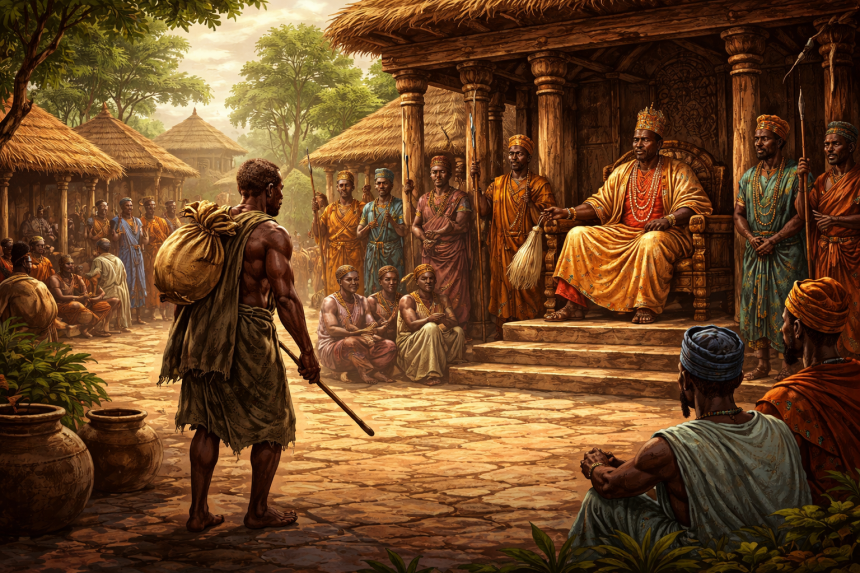
There is an ancient story of a great hunter from a particularly famous town, a great town of nobles, heroes, warriors, hunters, princes, and princesses. This man was so great at hunting that he specialised in pursuing lions, tigers, elephants, leopards, and many other carnivorous animals. His skill and fame led the people of his town to give him the alias “a man with seven lives” (elemi meje). He earned this name because he was known for going into the forbidden forest to hunt alone and always returned home alive with an abundance of animals he had killed. He sometimes spent two to four weeks away on a single hunting journey.
Over time, his community crowned him king after the former king’s death. From a hunter, he became a king. In Yoruba land, we call such a person an Oba, and he was, of course, from one of the royal lineages of his town. After he became Oba, he grew more famous, greater, richer, wealthier, and kinder. Many kingdoms, towns, and cities sought his generosity, his political influence, and his defence against aggression. He was a generous man with a large and fortified palace built to accommodate his wives, children, servants, and personal army.
One day, he remembered that since becoming Oba, he had not hunted even once. The demands of his kingdom had nearly made him forget the very profession that had brought him power, wealth, and fame. He longed to hunt one more time, as he had in the good old days.
He made up his mind. Like the saying goes, once a soldier, always a soldier. He mounted his horse, armed with guns and other hunting materials. Before he became Oba, he had gone hunting alone, trekking miles into the forest on foot. As Oba, however, there was no way he could be permitted to enter the forest alone again, because a king does not walk unaccompanied, and his town and his chiefs would not allow it.



So as he set out for the hunt, he took along some of his servants and guards. The servants carried cooking ingredients, smoked fish, cooking pots, and water for the journey, along with fighting and defensive tools, including charms and bangles.
After travelling into the forest for about one and a half hours, the king paused the journey and ordered his servants and guards to build a temporary hut. This was necessary because his hunting journeys had always ranged from two to four weeks, and that had not changed now that he was king. Many great hunters operated the same way, with some spending months in the forest before returning home. A temporary hut served several purposes: beyond rest, it was a place for cooking and eating, and a storage facility where killed animals could be prepared and smoked until dry, ready to be transported home.
Once his servants began building the temporary hut, the Oba set out alone into the thick forest. The hunt had begun. He told them he would return in two days. Immediately after making his third and final sacrifice to the gods of the forest for protection and good fortune, the sky grew overcast and the day gradually became darker. At last, the heavens opened and heavy rain began to fall. As he moved through the storm and the calamity of an unfamiliar forest he had never entered before, he eventually spotted fire smoke rising from a hut in the distance. He followed the path of the smoke, which led him to a place where he sought temporary refuge until the downpour was over. He introduced himself to the man and his family simply as a hunter who had come to the forest for hunting. He never told his hosts that he was a king, because he had left behind everything associated with royalty: his crown, his beads, his servants, and his guards. He had ventured out hunting like an ordinary man from his temporary hut. His hosts had no idea that the hunter standing before them was a great and celebrated king from a great and celebrated kingdom.
As is the custom in many Yoruba and African societies, a host must prepare food for visitors, whether strangers or familiar faces. Guests must be entertained and made comfortable. The man called his wives and instructed his children to slaughter one of their he-goats, as there was nothing else available in the house, and to prepare it for their distinguished visitor. They killed a he-goat and made soup for the stranger. When the food was presented to him, the soup was rich with an assortment of meats, including kidney, tripe, meat, intestines, and heart. But the hunter-king ate only the heart of the animal, as he normally did in his palace. His hosts did not know who he was, because he had not told them he was an Oba and he was not dressed as one. When the host observed that his visitor had eaten only the heart from the generous bowl placed before him, he decided to slaughter another he-goat, reasoning that eating only a heart from a soup full of various meats could not have satisfied their guest. The second he-goat was killed, and again the hunter-king ate only the heart. A third was killed and presented before him, and he did the same. This continued until the twelfth and final he-goat in the house was killed, and their visitor, the hunter-king, ate its heart as he always did. Night fell and the rain continued to pour heavily. They all went to sleep. The following morning, the hunter gave his warm thanks to the man, his wives, and his children for their hospitality and kindness toward him as an unknown stranger, and prepared to return to the forest for the hunting that had brought him there in the first place.


As he was being escorted out of the hut by his host, the hunter noticed the carcasses of dead animals lying in the garden within the man’s compound. He looked at his host and gave thanks to the gods that the compound was fenced with long and formidable wooden posts, which had protected them safely through the night. He assumed it was the Ìkokò or kọ̀lọ̀kọ̀lọ̀ (hyena or fox) that had killed those he-goats and would have devoured them entirely. The man looked at him and smiled, then told him that those he-goats had not been killed by the Ìkokò or kọ̀lọ̀kọ̀lọ̀. Every one of them had been slaughtered for him, because the host had noticed that his visitor loved eating animal hearts, and as their guest, it was his duty to ensure the visitor received full satisfaction, as their culture demanded and obliged him to provide.
On hearing this, the hunter was shocked and amazed. It was only then that the hunter-king realised that eating the heart had become such a deeply ingrained habit of his. The host further explained: when we gave you the first meal, you only ate the heart and left everything else. I had to kill a second he-goat and prepare it for you. The same thing happened again. That is how we came to kill the third, the fourth, the fifth, and so on, all the way to the last one we had in the house, which was the twelfth. The hunter looked up and looked down, reflecting in his heart that his host was truly a generous and kind man.
The hunter looked at the man with great amazement and gratitude and asked: you mean you did all this for me? Yes, his host responded, we did it all for you. He further told the hunter not to worry, because once he had taken his leave, his wives and children would prepare the remaining meat and preserve it for later use. To this day, many peoples across Yoruba land and the broader African world still observe this act of kindness and generosity toward any stranger who seeks refuge in their home.
Graciously, the hunter-king reached into his pouch and brought out something resembling what one might today call a premium card, and gave it to the man. The king kept two types of plate emblems. The first belonged to his Personal Assistant, a powerful figure in the palace. A bearer of the PA’s emblem still commanded a measure of respect, but would be subject to searching and would need to arrange an appointment before seeing the king. The plate emblem the king kept personally was different altogether. Whoever received it directly from the king’s hand could walk straight to him without waiting, without being searched or questioned by any guard, even if the king was eating or in the middle of a meeting. Everyone knew that only the king himself could give out that emblem, and so its holder carried the king’s own authority. It was also an obligation that any visitor entering the kingdom for the first time who carried the king’s personal plate emblem would be met by the indigenes, who would stop whatever they were doing and take that visitor straight to the palace without delay.
So the king told the man to protect and keep the plate emblem in a safe place. He should not lose it, because without it, it would be very difficult to locate him and gain access to him. He further instructed his host that whenever he decided to visit him in his town, he should make sure to carry the plate emblem and show it to whoever he met along the way. The hunter thanked him warmly and repeatedly, and left.
After a few moons had passed, the king grew eager to see his friend, the man who had hosted him in the forest. But the man never came, until one day famine struck the forest man’s land. There was no food to eat, and it seemed as though the gods of the forest had caged all the animals. The forest man remembered the visitor’s promise that he could come at any time and make any request, and that it would be fulfilled without hesitation.
He held a brief meeting with his wives and children, then set out on a long journey to find the hunter-king, hoping the man might be able to help him bring some food back home for his family. He picked up his pouch, which contained the plate emblem, and hit the road. On arriving at the king’s town, he showed the plate emblem to the first person he encountered near the entrance of the kingdom. That person had been on his way out somewhere urgent, but he turned back and took the forest man straight to the king’s palace. It was at this point that the man began to understand that the hunter he had hosted in the forest must indeed have been a person of great standing, to be living in such a palace.



On seeing the hunter-king seated on his throne, he was shocked. He had never imagined that the man he had hosted in his forest hut some years back was actually a great king. The king was in the middle of an important meeting with his chiefs when the man entered. The forest man noticed, however, that the king’s expression toward him appeared displeased and unhappy. This caused the forest man to ask whether the king had forgotten him. The king responded in a helpless voice, saying that there was no way he could ever forget such a kind-hearted man.
The king said: I remember you as clearly as if it were yesterday, but you have come to this town at the wrong time, and that is why I am not happy. He continued: look, my friend, there is no way I can be happy, because today we are performing a human sacrifice to one of our gods. What we are waiting for is the alálẹ̀ (the owner of the land, which also means god) to bring the final material for the sacrifice, as it always does every five years. And then you walked in. You, who were so good to me during my hunting journey, should not have come today. You are a good man. The king had already told his chiefs about this man on a previous occasion. Despite that, the chiefs believed it was their god that had brought the man to them so that he could be used as the sacrifice. The king was not happy, but the law was the law, and all the chiefs were waiting for the final pronouncement from their king so that the sacrifice could proceed.
The forest man was disheartened. However, he understood the traditions and culture of many lands and what their gods demanded in terms of materials for sacrifice. The king was now at a crossroads, in a very difficult situation, and a decision had to be made. The forest man understood the consequences the king would face if he went against the decision of his chiefs and, most especially, the High Priest of the land. Wanting to help the king out of the dilemma, the forest man, the very one who was to be sacrificed, stepped forward and spoke. He said: my king, if that is the case, do not worry yourself. I accept what the god has demanded as my curse and destiny. The king’s eyes went red like blood, and he grumbled quietly in pain. In the end, the king agreed, and all the chiefs and priests were satisfied. The executioner was then summoned with the guards to take the man to the shrine so that the ritual could begin.
On arriving at the shrine, the forest man pleaded with the executioner. He explained that there was great hunger in his area: no food, and not even animals in the forest, as though the gods had caged them all. It was because of this that he had made the long journey to the king for help. He begged the executioner to allow him to go back home and tell his wives and children everything that had happened and what would become of him, because they were waiting for him to return with food. By going home, they would at least know that food was not coming, and this would spare them the agony of waiting and searching for him. He pleaded sincerely, promising on his life to return and lay himself down as demanded. After a great deal of conversation and pleading, the executioner trusted him with his life, and the man went.
After a while, the king and chiefs waited for the executioner to return and bring them the good news that they had finally sacrificed the man to their god. When they could not find him, the king and his chiefs rushed to the ritual place. On arriving, there were no blood spills on the ground. They could not find the man, let alone his head. They asked the executioner what had happened and where the man they were supposed to use for the sacrifice was. The executioner explained what had taken place: he had let the man go briefly to inform his family what he had found here and what would become of him thereafter. The chiefs were shocked and said: are you a moron? How could you allow somebody that our god brought for the sacrifice to escape by tricking you and by falling to his superior charm power? You allowed him to go back. Do you think that he is a daft man, that he will come back for you to kill him? Are you not thinking at all? Do you know the consequences of what you did? Definitely, you will be the one we have to sacrifice to our god. As the matter was argued back and forth, at the end the executioner accepted his fate without complaint, because that was the law of the land: once you allow the person meant for sacrifice to escape, whoever permitted that to happen would be used in that sacrifice’s place. They bound him with ropes and laid him down on the ground.
As a matter of urgency, another executioner had to be appointed. While the chiefs deliberated over who should fill the role, the king turned to the executioner bound on the ground and asked him to name someone from among those who had worked closely alongside him for years who could serve as the new executioner.
As the new executioner was about to be appointed, one of the guards at the shrine signalled that he had spotted a light approaching briskly in the direction of the ritual place. Everyone grew anxious, wondering who it could be, because everyone in the town and the surrounding area knew that a ritual was taking place and that nobody was permitted to be out walking during such late hours of a silent night. Suddenly, the distant light drew nearer with the speed of a breeze, and to everyone’s shock and amazement, it was the stranger who had come back. They asked him why he had returned after the executioner had let him go. The forest man responded that his family had been expecting him to come back home with food, and that not seeing him return would only cause them greater worry. He said: I needed to go back and lessen their worry, because if they did not find me coming back, they would be worried about not seeing me and about the food. Instead of them worrying and searching for me, I, as a man, needed to go back and tell them what happened here. I pleaded earnestly with the executioner and pledged to come back, because I knew that if I did not return, his head would be used to replace mine. And since I promised him with my life that I would come back, that is why I have returned: to save a man who did me a favour, and to see my family one last time before I die in a strange land.
Everyone was amazed, shocked, and moved. An emergency meeting was held, and the king and chiefs decided not to execute the man, for they saw before them a man of rare honesty and integrity. They quickly appeased the spirits of their ancestors. The Ifa oracle was consulted and spoke. Many sacrifices were made before the first cock crowed, and from that day forward, human sacrifice was abolished in that land. The god accepted twelve he-goats as a replacement for the human sacrifice.
The forest man was commended before the assembled chiefs and people for his bravery, his hospitality toward their king during the hunting journey, and for returning to the shrine exactly as he had promised. They told him: the fact that you went and came back, knowing that your failure to return would have cost the executioner his head, proves that you are a man of your word and a man of integrity.
On the third day, the forest man pleaded with the king for permission to return to his family, who by that time would certainly believe he was dead and would be in mourning for him. The king granted his request and prepared twenty servants and three horses to accompany him back home, carrying with them an abundance of food, cowries, beads, and fine attire. The king also set aside some of the faraway towns and villages under his command and appointed the forest man as their king, to administer them on his behalf. Three months were set aside for his coronation as king. The man thanked the king, the chiefs, and all the king’s subjects for the grace and honour that had been bestowed upon him. And so the man returned to his hut as a wealthy man and a king in the making.
The moral lesson of this story is that it is good to be good and kind to everyone you meet along the journey of life, and that living by honesty and integrity is always worthwhile. There are many lessons woven through this tale: a king who disguised himself and concealed his identity when he went hunting; a man who sacrificed everything in his home to feed a stranger he did not know, a stranger who had appeared at his doorstep uninvited. That same stranger, on seeking help from the hunter-king, met death upon arrival at the palace. Yet he remained calm, never lost his composure, never cursed anyone for his fate, and steadied himself with quiet dignity through the worst of moments, not knowing that there was light waiting at the end of the tunnel. And from that trial, he rose. From grass to grace, he became a king under the authority of the very great hunter-king himself.