




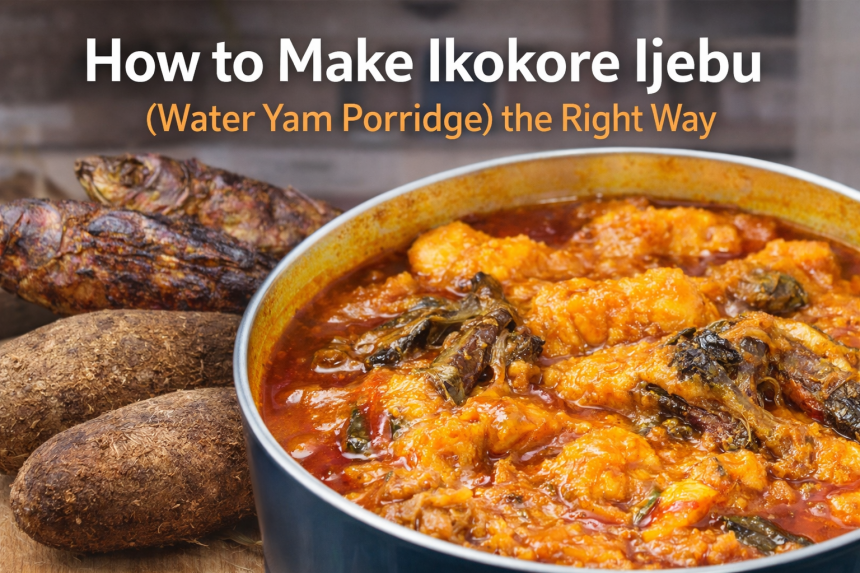
Ikokore is simple on paper and unforgiving in practice. That is the truth most recipes avoid. The smell reaches you first, earthy, smoky, and deeply savoury, and for anyone raised in an Ijebu household, it carries the weight of memory. This is food that belongs to the Ijebu people of Ogun State, where water yam is not a substitute ingredient but the centre of the meal. At its core, Ikokore is a slow-cooked water yam dish where grated yam thickens a richly seasoned palm oil broth.
What Makes Ikokore Ijebu Different
The defining ingredient is isu ewura, water yam (Dioscorea alata), not the firm white yam used for pounded yam. Water yam is viscous and slightly mucilaginous when raw, and when grated and added to a simmering broth, it thickens the liquid from within, producing soft, yielding chunks. The dish is also known as Ifokore, and both names refer to the same thing.
The Ijebu people of Ogun State have long been associated with a distinctive approach to food. The broth is rich with palm oil. The crayfish is never an afterthought. Agbodo (Bonga fish) and Shawa (Herring fish) contribute a deep, smoky base that generic smoked fish cannot replicate. Ede, dried shrimp, layers in a quiet intensity that experienced cooks understand is not optional but foundational. Together, these ingredients give Ikokore its unmistakable depth.
What separates a well-made Ikokore from a mediocre one is the timing and method of adding the yam. Add it gradually, in portions, and the dish develops a layered quality, with some pieces fully dissolved and others still holding a little resistance, that experienced cooks recognise as the mark of patience.



Ingredients You Will Need
Ikokore is sensitive to imbalance. Too much liquid weakens it. Too little fat or seasoning makes it dull. For a pot that serves four to six people, you will need:
- 1 large tuber of water yam (isu ewura), peeled and grated
- 3 to 4 cooking spoons of palm oil (approximately 150 to 200ml), adjusted to control richness and colour
- Fresh pepper blend: scotch bonnet (ata rodo) and bell pepper, blended until smooth
- 1 to 2 medium onions, finely chopped
- Smoked fish: Agbodo (Bonga fish) and/or Shawa (Herring fish), cleaned and deboned
- Ede (dried shrimp), rinsed
- Dried fish: Catfish (Ẹja àrọ̀), dried and cleaned (optional)
- Panla (dried fish, typically hake or similar white fish), soaked overnight or pre-boiled until softened (optional)
- Assorted meat, ponmo (cowskin), beef or tripe, all pre-cooked (optional)
- 3 to 4 tablespoons ground crayfish
- Ogiri Ijebu (fermented melon seed condiment)
- Seasoning cubes and salt to taste
Ogiri Ijebu introduces a subtle, earthy complexity that distinguishes authentic versions of this dish from adaptations. It is not the same as iru (fermented locust beans), and the two are not interchangeable. If unavailable, leave it out rather than substituting iru. Optional additions include periwinkle (isawuru), traditional in coastal Ijebu households.
Preparing the Water Yam
This is where most errors begin. Grate the water yam; do not blend it. Blending produces a uniformly smooth paste that disappears entirely into the broth. Grating preserves the fibrous texture that allows Ikokore to form its characteristic lumps.
Do not discard the starchy liquid released during grating. That starch is what allows the dish to thicken and hold structure. Season the grated yam lightly with salt and a small amount of seasoning powder before cooking, since the lumps will cook largely undisturbed. One practical caution: raw water yam causes skin irritation. Keep it away from the forearms and face. If contact occurs, apply palm oil to the affected area immediately.

Cooking Method
Build the Flavour Base
Heat the palm oil over medium heat until translucent, two to three minutes. Do not allow it to smoke. Add the onion and fry until softened, roughly three minutes. Add the blended pepper and cook down for four to five minutes, stirring regularly, until the oil begins to separate and the raw edge is gone. Add the crayfish and Ogiri Ijebu, stir through, and cook for one further minute.
Build the Broth and Remove Proteins
Pour in water as your cooking liquid. Add the Agbodo, Shawa, dried catfish, ede (dried shrimp), and ponmo or meat if using. If using Panla, rinse it first and add it here as well. Bring to a steady simmer and cook for ten minutes, tasting and adjusting seasoning gradually. Before adding the yam, remove all fish and meat using a slotted spoon and set aside. This step is not optional. Proteins left in during the yam stage will break apart, sink, and burn.
Introduce the Grated Yam
Reduce the heat so the broth simmers without rolling. Add the grated yam in spoonfuls, distributing them across the surface of the pot. Do not stir. Leave completely undisturbed for eight to ten minutes on low heat. Once the yam has firmed up, stir once, gently, with a wooden spoon. Small portions will dissolve into the stock, forming a creamy base; larger portions will remain as soft lumps. Both are correct. Neither should be stirred away.
Finish and Rest
Return the reserved fish, meat, and periwinkle (if using) to the pot. Cover and cook on low heat for a further five to eight minutes. If the porridge becomes too dense, add a small measure of hot water and fold carefully. Taste and adjust seasoning.
The final Ikokore should be thick, cohesive, and lightly springy when pressed. It should not flow like porridge. If needed, add a small amount of fresh palm oil to enrich the surface, then remove from heat and allow the pot to rest uncovered for several minutes before serving. Resting is not decorative. It stabilises the structure.
Why Cold Eba Is the Right Partner
In Ijebu culinary tradition, Ikokore is paired with eba tutu, cold eba served at room temperature rather than hot. Where Ikokore is hot, dense, and richly coated, the cool firmness of eba tutu provides a contrast that hot eba cannot. The palm oil clings to the cooler surface in a way it would not against hot eba, carrying the full flavour of the porridge into each mouthful. The temperature differential is part of the eating, not incidental to it.
To make eba tutu, prepare eba in the usual way, then allow it to cool to room temperature before serving. Ijebu garri produces a richer, more pronounced flavour that suits the intensity of Ikokore well.



Practical Insight
In many Ijebu homes, Ikokore is not everyday food. It is prepared when there is time to cook properly. That alone explains its character. This is not fast food. It is controlled cooking. And controlled cooking demands attention.
Use fresh palm oil. Oil stored too long develops a rancid note no crayfish will conceal. Season boldly. Grate the yam immediately before cooking, as it oxidises quickly when exposed to air. Ikokore depends on depth, not heat from pepper alone.
Cultural Context
Ikokore reflects a traditional approach to food where patience and method define outcome. Water yam, often overlooked in modern urban cooking, becomes the centrepiece here. That is not accidental. It is cultural memory expressed through food. What is often ignored elsewhere is preserved here.
Final Thought
Ikokore rewards precision. It does not forgive carelessness. Cooked properly, it is rich, grounded, and deeply satisfying. Cooked poorly, it collapses into something forgettable. The difference is not in the recipe. It is in the execution.