




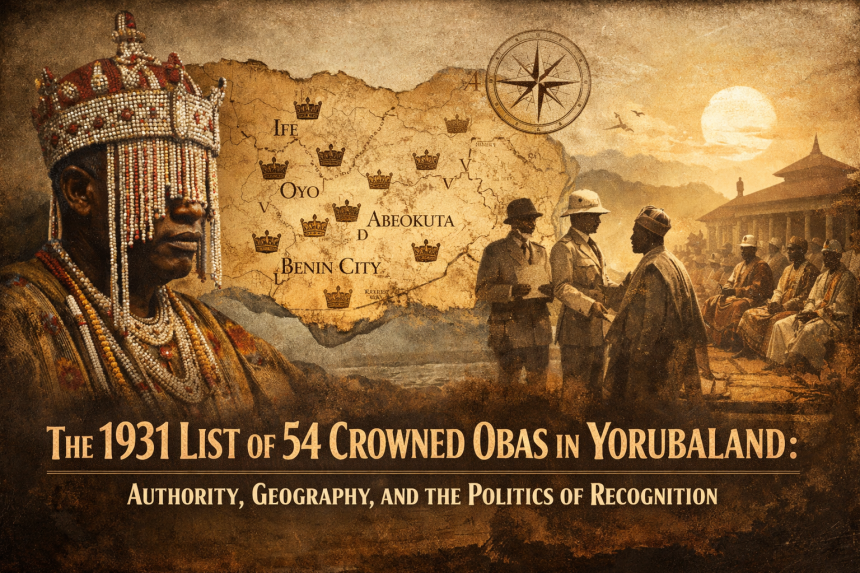
In 1931, during the consolidation phase of British colonial administration in Southern Nigeria, a document was produced that was far more consequential than its format suggested. A formal list of fifty-four Obas in Yorubaland was compiled, recognising each as entitled to wear beaded crowns. Later reproduced in the Nigerian Tribune on 6 April 1987, it has since become one of the most referenced documents in discussions of Yoruba kingship, hierarchy, and legitimacy.
What makes the list significant is not simply who appears on it. It is that the act of compiling it at all reveals the pressure point where two entirely different understandings of authority were forced to negotiate. On one side stood a colonial administration that required legibility, classification, and administrative order. On the other stood a political tradition that had never organised itself into a single chain of command and had never needed to. The list is the record of that negotiation.
To understand it properly requires examining three interconnected realities: the deep structure of Yoruba kingship before colonial intervention, the logic of British indirect rule and its requirement for classification, and the geographic distribution of authority across Yorubaland and what it reveals about centuries of political evolution.
Yoruba Kingship Before Colonial Codification
Long before 1931, Yoruba political authority operated as an interconnected but deliberately plural system. Ile-Ife sat at its spiritual centre, revered across Yorubaland as the origin of human civilisation and the seat of Oduduwa, the ancestral progenitor. The Ooni of Ife drew his significance not from military power but from ritual seniority. He was the custodian of origin.



Around this sacred centre, distinct polities built their own power. The Alaafin of Oyo presided over the Oyo Empire, which from the seventeenth to early nineteenth centuries was one of the most formidable political and military formations in West Africa, exerting dominance across large parts of Yorubaland and into present-day Benin Republic and Togo. The Awujale of Ijebu governed a commercially sophisticated coastal kingdom that controlled critical trade routes. In Egba territory, the Alake emerged as a principal figure in the reorganisation of authority following the collapse of Old Oyo and the inter-Yoruba conflicts of the nineteenth century.
None of these rulers existed within a single-ranked hierarchy. Power was distributed, not concentrated. Status derived from antiquity, military capacity, ritual lineage, commercial influence, and political resilience, often in combination. Different kingdoms held different kinds of authority, and the system functioned precisely because those differences were recognised rather than flattened.
The beaded crown, the ade ileke, was central to this system. It represented ase, the divine mandate that separated a sacred king from a mere chief. But not all crowns were identical, not all polities enjoyed equal standing, and the question of who was entitled to wear one had always been understood in ritual rather than administrative terms.
When British colonial pressure intensified across Yorubaland in the 1890s, it proceeded through separate and distinct processes. The 1893 treaty placed Oyo under British protection. Ibadan’s submission to protectorate authority followed through separate arrangements. The subordination of Yoruba military power was not a single event but a series of negotiations, treaties, and interventions that unfolded across the decade. Together, they brought an intricate web of monarchies under colonial oversight. The British challenge was not to destroy that web, which would have been both costly and destabilising, but to render it legible for administrative purposes. The 1931 list was their solution.



The 1931 List of 54 Crown-Entitled Obas
The list, reproduced here as published in the Nigerian Tribune of 6 April 1987, recognised the following rulers as entitled to wear crowns:
- Ooni of Ife – Ile-Ife, Osun State
- Alaafin of Oyo – Oyo, Oyo State
- Olowu of Abeokuta – Owu, Abeokuta, Ogun State
- Oba Ado of Ado Bini – Ado (present-day Benin City area), Edo State
- Oore of Otun Ekiti – Otun Ekiti, Ekiti State
- Orangun of Ila – Ila-Orangun, Osun State
- Awujale of Ode – Ijebu-Ode, Ogun State
- Apero of Ijero – Ijero-Ekiti, Ekiti State
- Olojudo of Ido Ogundaru – Ido (Ogundaru area), Ekiti region
- Ilara of Ara – Ilara-Mokin (Ara), Ondo State
- Elekole of Ikole – Ikole-Ekiti, Ekiti State
- Owa of Ijesa – Ilesa, Osun State
- Oloye of Oye – Oye-Ekiti, Ekiti State
- Alake of Abeokuta – Abeokuta (Egba Alake), Ogun State
- Ewi of Ado – Ado-Ekiti, Ekiti State
- Alaaye of Efon – Efon-Alaaye, Ekiti State
- Ologotun – Ogotun-Ekiti, Ekiti State
- Akarigbo of Sagamu – Sagamu (Remo), Ogun State
- Oloyi Ife of Oyi Ife (Jebba) – Oyi-Ife, Kwara State
- Agura of Abeokuta – Gbagura (Egba Gbagura), Abeokuta, Ogun State
- Ogoga of Ikere – Ikere-Ekiti, Ekiti State
- Osemawe of Ondo – Ondo Town, Ondo State
- Oshile of Abeokuta – Egba Oke-Ona (Oshile), Abeokuta, Ogun State
- Elemure of Emure – Emure-Ekiti, Ekiti State
- Onigbajo of Igbajo – Igbajo, Osun State
- Olowo Oko of Owo – Owo (Olowo Oko lineage), Ondo State
- Olowo Ile of Owo – Owo (Olowo ruling house), Ondo State
- Ewusi of Sagamu (Onimakun) – Sagamu (Remo), Ogun State
- Onise of Ise – Ise-Ekiti, Ekiti State
- Olojudo of Ido Efon – Ido-Efon, Ekiti State
- Owa of Idanre – Idanre, Ondo State
- Alajogun of Ajase – Ajase (historically a Yoruba settlement in present-day Benin Republic)
- Oba Dada of Dahomey – Dahomey (present-day Republic of Benin)
- Onibara of Abeokuta – Egba (Onibara), Abeokuta, Ogun State
- Onire of Ire ti Oye – Ire-Ekiti, Ekiti State
- Oloton of Oton Koro – Oton (near Koro), Kwara State
- Owa Igbara of Igbara – Igbara-Odo, Ekiti State
- Olojudo of Ido Oshun – Ido-Osun, Osun State
- Oniseri of Iseri – Iseri, Ogun State
- Oloja Oke of Imesi I – Imesi-Ile, Osun State
- Oloja Oke of Imesi II (now Owa-Ooye of Okemesi) – Okemesi-Ekiti, Ekiti State
- Ologere of Ogere – Ogere-Remo, Ogun State
- Oba of Obagun – Obagun, Osun State
- Elepe of Sagamu (Alupon) – Sagamu (Remo), Ogun State
- Owalubo of Ubo – Ubo-Ekiti, Ekiti State
- Onilawe of Ilawe – Ilawe-Ekiti, Ekiti State
- Onipokia of Ipokia – Ipokia, Ogun State
- Onitede of Tede – Tede, Oyo State
- Olohan of Ohan (Ara) – Ohan, Ondo State
- Alapa of Agbonda – Agbonda (historical Yoruba settlement, Ondo region)
- Oloba of Akure – Akure, Ondo State
- Oniro of Iro – Iro-Ekiti, Ekiti State
- Olota of Otta – Ota, Ogun State
- Onitori of Itori – Itori, Ogun State
Two entries require particular contextual care and should not be read without explanation. Entry 4, Oba Ado of Ado Bini, refers to a Yoruba-linked title within Benin territorial jurisdiction, reflecting the historical settlement of Yoruba communities in and around Benin City and the dynastic cross-connections between the two civilisations. It does not refer to the Oba of Benin, who presides over a distinct Edo monarchy with a wholly separate dynastic tradition and is not included on this list. Benin political authority historically extended over multi-ethnic settlements, and the presence of a Yoruba-linked ruler within that jurisdiction reflects the complexity of that regional order rather than any Yoruba claim over Benin territory. Similarly, Entry 33, Oba Dada of Dahomey, does not refer to the Fon monarchy that governed the Kingdom of Dahomey, which was an entirely separate political and ethnic formation. It refers specifically to Yoruba dynastic presence within Dahomean territory, a reflection of the deep Yoruba settlements and royal lineages that extended beyond what is now Nigeria’s western border. The 1931 list was mapping Yoruba political geography, not asserting Yoruba sovereignty over the kingdoms within which some of those Yoruba rulers resided.
It is also worth noting that colonial codification of this kind was rarely a purely top-down exercise. The classification of rulers, the recognition of crown entitlement, and the ranking of competing claims frequently involved negotiation with Yoruba elites and intermediaries who had their own interests in how the list was structured. The 1931 register should therefore be understood as a negotiated document as much as an imposed one.
What the Geography Reveals
Read geographically rather than administratively, the list tells a different and richer story.
The concentration of crown-entitled rulers in present-day Ekiti State is the most striking feature. Towns such as Ado-Ekiti, Ikole-Ekiti, Ijero-Ekiti, Oye-Ekiti, Efon-Alaaye, Emure-Ekiti, Ise-Ekiti, Igbara-Odo, Okemesi-Ekiti, Ilawe-Ekiti, Ogotun-Ekiti, Ubo-Ekiti, and Iro-Ekiti all appear. This density reflects two converging historical realities. The first is the longstanding political structure of Ekiti country, which consisted of numerous autonomous kingdoms rather than a single dominant centre. Unlike the Oyo Empire, which built a centralised military and administrative apparatus and imposed tributary relationships across a wide territory, Ekiti polities retained strong local independence even during periods of external pressure. The second reality is more specific to the nineteenth century. Much of Ekiti settlement geography was shaped by defensive patterns during the prolonged inter-Yoruba wars of that period, particularly the Ekitiparapo resistance of the 1870s and 1880s. Towns were consolidated or fortified in ways that reinforced local autonomy rather than regional centralisation. The density of crown-entitled rulers in Ekiti is therefore not merely a reflection of ancient political structure. It is also the legacy of a century of defensive fragmentation. When the British compiled their list, they were recording the outcome of both processes simultaneously.
Abeokuta and Sagamu present a different but equally instructive pattern. The Alake, Olowu, Agura, Oshile, and Onibara of Abeokuta represent the internal divisions of Egba authority, each rooted in the distinct Egba sub-groups that migrated and consolidated in the nineteenth century following Old Oyo’s collapse. Within Sagamu, the Akarigbo, Ewusi of the Onimakun line, and Elepe of the Alupon line each command distinct authority within the same geographic area. The parenthetical qualifiers preserved in the original list, Onimakun and Alupon, are not incidental detail. They specify lineage distinctions that determined which family held legitimate claim to each title across generations. That the colonial administration chose to preserve these distinctions rather than selecting a single paramount for each town reveals something important: indirect rule in Yorubaland depended on stability, and stability meant respecting the existing distribution of authority rather than rationalising it into a cleaner administrative shape.
The Ondo and Ijesa zones add further depth. The Osemawe of Ondo, Olowo of Owo, Owa of Idanre, Ilara of Ara, and Oloba of Akure represent monarchies whose roots predate colonialism entirely. In Osun State, the Ooni of Ife, Owa of Ijesa, Orangun of Ila-Orangun, and Onigbajo of Igbajo reflect the enduring influence of central Yoruba polities that had long operated with significant autonomy. Entry 19, the Oloyi Ife of Oyi-Ife in Kwara State, deserves particular notice. Kwara fell within the Northern Region under colonial administration, meaning the 1931 list crossed not only modern state boundaries but colonial administrative divisions entirely. The northern frontier of Yorubaland was also historically fluid, with areas such as Oton Koro sitting at the intersection of Yoruba and Nupe cultural influence, a reminder that the political geography of Yorubaland did not have sharp ethnic edges even within its own territory.



The inclusion of Ajase and Dahomey remains the most historically striking aspect of the entire document. The 1931 list was not a Nigerian document in any modern territorial sense. It was a document of Yoruba political history, which had never organised itself according to the borders that colonial cartography was then imposing across the continent.
Why the British Needed the List
The compilation of a formal register of crown-wearing Obas was not a gesture of cultural appreciation. It was a requirement of administration, and a precisely functional one that served several simultaneous purposes.
Under the Native Courts Ordinance and the broader structures of indirect rule, traditional rulers were the delivery mechanism for colonial governance. Native Courts required recognised presiding authorities. Provincial Councils required identified representatives. Tax collection required legitimate intermediaries who commanded local compliance. Stipend allocations required a grading system, and grading required classification. Recognition of a ruler as crown-entitled determined access to all of these functions, and without formal recognition, a ruler had no administrative standing regardless of how deeply entrenched his authority was within his own community.
The list was also a political technology of control in a more direct sense. By formally designating which rulers held recognised standing, colonial administrators reduced the space for competing monarchs to appeal directly to British officers when jurisdictional disputes arose. Rival claims to court authority, tax territory, and ceremonial precedence had previously created administrative friction that disrupted the reliable flow of revenue and judicial order. A codified list shortened those disputes. It did not eliminate them, but it gave the colonial state a reference point that could be invoked to close arguments that would otherwise have remained perpetually open.
What the British notably did not do was designate a single paramount Oba over all of Yorubaland. Unlike parts of Northern Nigeria, where the indirect rule model found a cleaner structural fit with large emirate formations, Yorubaland presented a multiplicity of centres that resisted reduction to a single apex. Whether the decision to preserve that multiplicity reflected sensitivity to Yoruba political culture or a practical calculation that no such designation would survive without generating serious resistance from excluded monarchies, the effect was the same: the constellation structure of Yoruba authority was preserved within the colonial framework rather than collapsed into a hierarchy the tradition had never required.
The Conferences of Yoruba Obas, 1937–1942
Six years after the list was formalised, a series of conferences brought the Obas together in person. The first was held at Oyo in 1937. The second followed at Ile-Ife in 1938. Subsequent gatherings took place at Ibadan in 1939, Abeokuta in 1940, Ijebu-Ode in 1941, and Benin City in 1942.
At each conference, the Ooni of Ife presided. By custom, he sat facing east, with other Obas arranged to his right and left. The directional symbolism was deliberate. East in Yoruba cosmology is associated with ancestral origin and spiritual renewal. The Ooni’s presiding role did not signify political supremacy over other monarchs. It signified ritual seniority, the weight of origin rather than the command of empire.
That distinction sat at the centre of one of the most politically charged and enduring debates in twentieth-century Yoruba public life: the question of precedence between the Ooni of Ife and the Alaafin of Oyo. During the height of Oyo imperial power in the eighteenth century, the Alaafin commanded tribute from kingdoms across Yorubaland and beyond. His authority was demonstrably imperial, sustained by military force, cavalry, and sophisticated administrative structures. The Ooni, by contrast, had never commanded an empire in the same territorial sense. His authority derived from something older and, in Yoruba understanding, more fundamental: the claim that Ife was the origin of Yoruba civilisation itself, the place from which all legitimate kingship descended.
These were not competing claims of the same type. One was a claim of political and military supremacy. The other was a claim of spiritual and ancestral primacy. Yoruba tradition had always accommodated both simultaneously, treating them as different orders of authority rather than as rivals for the same position. The difficulty was that colonial administration, post-independence governance, and public ceremonial protocol all required practical decisions about who sat where, who was greeted first, and whose title carried greater official weight. These decisions, which colonial officers treated as administrative convenience, carried enormous symbolic significance for the communities involved. The debate over Ooni-Alaafin precedence intensified through the mid-twentieth century, surfacing repeatedly in protocol disagreements, grading controversies, and public exchanges that were never purely abstract. They were arguments about which understanding of authority, the imperial or the sacred, would carry greater weight in a modernising Nigerian state. The conferences of 1937 to 1942 resolved the question pragmatically without settling it permanently: the Ooni presided, the other Obas sat beside him, and the deeper argument continued.
The conferences themselves occurred against the backdrop of the Second World War and rising nationalist sentiment across Nigeria. Whatever their ceremonial character, they served a practical function: they maintained structured communication among traditional rulers at a moment when regional stability carried particular value, colonial and indigenous interests briefly aligned around the shared imperative of order.
The 1987 Reproduction and Enduring Relevance
When the Nigerian Tribune republished the 1931 list in April 1987, Nigeria had undergone a transformation the original compilers could not have anticipated. The 1976 state creation exercise had divided the old Western Region into multiple states, redrawing the administrative map of Yorubaland and generating new questions about which traditional institutions fell under which state government authority. Under both military and civilian administrations of the post-independence period, traditional ruler grading had become a politically sensitive matter. State governments held the power to classify Obas into grades that determined stipend levels, protocol rank, and official recognition. During the Second Republic in particular, these classifications became sites of intense contestation, with long-standing precedence disputes acquiring new financial and political stakes.
In this context, the 1931 list served as historical evidence in ongoing arguments. Communities seeking higher classification or greater recognition could point to colonial-era documentation of their crown entitlement as a foundation for contemporary claims. The document’s age did not diminish its authority. If anything, it reinforced it, lending the weight of historical continuity to arguments that might otherwise have appeared recent or self-interested. That a document produced in 1931 could still carry evidentiary weight more than half a century later reflects not institutional conservatism but the depth at which kingship operates in Yoruba cultural and political life. When authority is contested, history is always called as a witness.
Conclusion
The 1931 list of 54 crown-entitled Obas in Yorubaland is, on its surface, an administrative document. Beneath that surface, it is something considerably more significant: a colonial instrument shaped by indigenous complexity, a geographic portrait of centuries of Yoruba political development, and a moment in the long negotiation between sacred authority and bureaucratic classification.
The central historical irony of the list is that it achieved the opposite of what colonial classification systems typically produced elsewhere. Rather than imposing a singular hierarchy, it preserved plurality. By attempting to describe Yoruba political authority as it actually existed, rather than as the logic of empire would have preferred it to be structured, the colonial administration inadvertently consolidated a record of distributed power that subsequent generations would use to defend precisely the autonomy the colonial state had otherwise sought to contain. In attempting to codify the constellation, the list made it permanent.
It did not create Yoruba kingship. It attempted to describe it. And in doing so, it preserved the irreducible plurality of a tradition that had always derived its strength not from centralised command but from the disciplined distribution of authority across place, lineage, and ritual function. The beaded crown endures not as ornament but as symbol of a civilisation that has adapted, survived, and never surrendered what it understood to be the source of its legitimacy.