




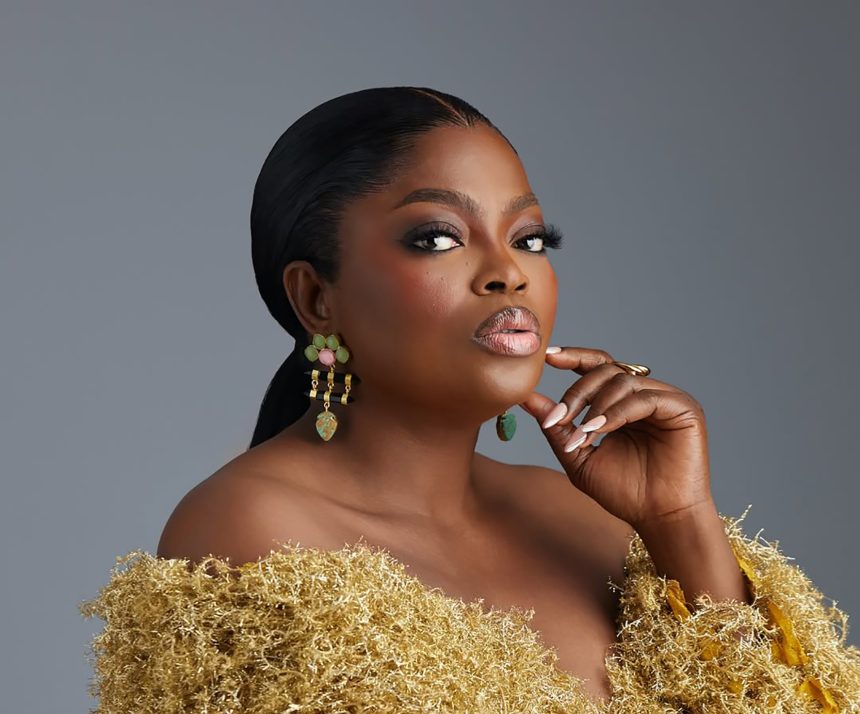
She did not simply rise through Nigeria’s film industry. She altered its architecture from within, one record-breaking film at a time.
There are actors, and then there are institutions. Funke Akindele belongs firmly in the latter category. Her career does not merely reflect the growth of Nollywood. It reveals how discipline, reinvention, and strategic control can turn talent into sustained cultural influence. More importantly, it is proof that audience trust, once earned, can be converted into enduring commercial power.
In December 2025, Nigerian cinemas were once again crowded. Not with curiosity, but with certainty. Audiences who had watched Akindele work the craft for nearly three decades arrived at theatres in Lagos, Abuja, Port Harcourt, and Accra knowing, with a fair degree of confidence, what they were going to get: a film that understood them. Behind the Scenes crossed one billion naira in nineteen days. It became the fastest film in West African cinema history to reach that milestone, and the highest-grossing Nollywood title of 2025. It was not her first time at that altitude.
The numbers are remarkable. The story behind them is more so.



Ikorodu to Unilag: A Formation Rooted in Lagos
Olufunke Ayotunde Akindele was born on 24 August 1977 in Ikorodu, a sprawling satellite town on the northern edges of Lagos, a metropolis that does not hand out second chances easily but occasionally rewards those relentless enough to manufacture their own. She is the second of four children. Her mother was a medical doctor; her father a retired school principal. Structure on one side, empathy on the other. That combination may explain something about the methodical way Akindele has navigated a career that most would have found unmanageable.
She attended Grace Children’s School in Gbagada, Lagos, before proceeding to Lagos State Model College, Igbo-Kuta, Ikorodu, for her secondary education. What followed was academically unconventional in the best possible sense. She pursued a diploma in mass communication at what was then Ogun State Polytechnic, now known as Moshood Abiola Polytechnic, before completing a law degree at the University of Lagos. The law degree has never been incidental. It surfaces in how she structures deals, how she defends her work in public discourse, and how she runs the commercial architecture of her production empire. Communication gave her voice. Law gave her structure. A trained lawyer who chose the screen is not a curiosity. She is a strategic operator who understood, early, that storytelling and leverage belong in the same sentence.
The Television Years: Foundation Before Fame
In 1998, Akindele stepped in front of a camera for the United Nations Population Fund-sponsored sitcom I Need to Know, playing Bisi, a curious and sharply intelligent secondary school student. The show aired until 2002 and addressed adolescent reproductive health, at the time a subject most Nigerian television either avoided or handled with visible discomfort. It gave Akindele something more valuable than visibility. It demonstrated what purposeful storytelling could achieve when aimed at the right audience at the right moment.
Her early cinema work was modest by design, not default. She observed. She adapted. She accumulated. What she was doing, though it may not have read as strategy at the time, was the kind of foundational accumulation that cannot be compressed or replicated. That accumulation would later become leverage.



Jenifa: The Role That Changed Everything
In 2008, Akindele produced and starred in a comedy-drama titled Jenifa. The film followed a young village woman navigating the social labyrinth of Lagos, armed with street intelligence, misplaced confidence, and an irrepressible energy that Nigerian audiences recognised immediately. It was not simply funny. It was a mirror held up to class aspiration, cultural dislocation, and the strange comedy of becoming someone you were not raised to be. Characters must feel lived in, not performed. Jenifa was both.
The film became a cultural phenomenon. It did not just perform well at the box office. It entered everyday conversation, generated a vocabulary, and gave Nigerians a character to argue about, quote from, and affectionately mock. In 2009, Akindele won the Africa Movie Academy Award for Best Actress in a Leading Role, a recognition that confirmed what the audience had already decided.
The Jenifa franchise grew from there. The Return of Jenifa arrived in 2011. The television series Jenifa’s Diary launched in 2015, ran for years, and became a fixture in Nigerian households. The series earned Akindele multiple Best Actress in a Comedy wins at the Africa Magic Viewers’ Choice Awards in 2016, 2017, 2020, and 2022. The character evolved as she did, and the audience evolved alongside both.
Beyond Comedy: The Architecture of a Filmmaker
What separates Akindele from most of her contemporaries is not the awards or the box office figures, though those are difficult to ignore. It is the conscious widening of her creative territory over time. She is not chasing novelty. She is building consistency, and audiences have learned to trust the difference.
In 2010, she starred in Omo Ghetto, a gangster film with real menace to it, one that influenced the tone and visual grammar of subsequent Yoruba-language popular cinema. It established her comfort with genre, not merely comedy. In 2019, she directed Your Excellency, a political drama that marked her formal debut behind the camera. The shift from actor to director is where many careers hit turbulence. Hers accelerated.
She co-founded SceneOne Productions, which later evolved into The Funke Akindele Network, a production framework that reflects a comprehensive understanding of how the Nigerian film business actually works: talent, distribution, marketing, and exhibition must be understood together, not in isolation.
The films she directed from 2020 onwards redefined commercial expectations in Nigerian cinema. Omo Ghetto: The Saga (2020) became the highest-grossing Nollywood film of its era, breaking every theatrical record then in existence and becoming the first Nigerian film to cross ₦500 million at the box office. Battle on Buka Street (2022) pressed the commercial case further. Then A Tribe Called Judah (2023) crossed a threshold no Nigerian film had reached before, surpassing one billion naira at the box office and briefly holding the record as the highest-grossing Nigerian film ever made. Akindele broke her own record with Everybody Loves Jenifa in 2024, which eventually reached 1.8 billion naira at the West African box office, surpassing every preceding Nigerian production. Behind the Scenes (2025) followed, making her the only Nigerian filmmaker to have crossed the one billion naira mark three separate times. Combined, her theatrical releases have generated over six billion naira at the box office, a figure with no precedent in Nollywood history.



Her ambitions extend beyond the cinema window. In March 2025, she co-directed Finding Me, a dramatic exploration of identity, emotional betrayal, and self-reclamation, released exclusively on Amazon Prime Video. Where her theatrical work is calibrated for mass audiences, Finding Me signals a deliberate engagement with streaming as a distinct creative and commercial channel, one in which character depth and narrative restraint carry more weight than opening-weekend urgency.
This is not momentum. It is control.
Behind the Scenes: Generosity as Burden
Behind the Scenes, released on 12 December 2025 and co-directed with Tunde Olaoye, follows Aderonke “Ronky-Fella” Faniran, a successful real estate entrepreneur whose generosity toward family and community gradually becomes a source of personal strain. What begins as responsibility becomes obligation, then expectation, then quiet exploitation. In West African social reality, this is not fiction. It is familiar. What Nigerians call “black tax” is not a slogan here. It is a narrative engine.
Akindele herself appears in a supporting role as Adetutu, the manipulative sister, a deliberate departure from her signature Jenifa persona. Reviewers noted the effectiveness of that choice. Scarlet Gomez carries the lead with restraint; Tobi Bakre provides the film’s dramatic weight. The ensemble, which includes Iyabo Ojo, Destiny Etiko, Ibrahim Chatta, Ini Dima-Okojie, and Uzor Arukwe, grounds the story in recognisable social textures.
Audiences recognise themselves in her stories, and that recognition drives return. Against a reported production budget exceeding one billion naira, the film crossed that same threshold at the West African box office within nineteen days of release, the fastest any Nollywood production had done so, eventually surpassing two billion naira and becoming the first Nollywood film in history to cross that mark. When recognition is the product, the audience pays.
The Business Behind the Persona
It is tempting to frame Funke Akindele as a creative force alone. That would be incomplete.
She operates with the discipline of a business leader. Her projects are not random. They are positioned. Release strategies are deliberate; December has become her season not by coincidence but by sustained execution. Storylines are calibrated for audience familiarity while retaining enough tension to sustain engagement. Marketing integrates traditional media and digital platforms in a way that few Nollywood productions have managed with such operational clarity.
She does not merely understand her market. She anticipates it, and in doing so, shapes it. That precision shows in the production values, in the scale of ensemble casts she assembles, and in the decision to invest over one billion naira in the production budget of Behind the Scenes, an act of commercial confidence that most producers in the industry could neither afford nor justify.
The business logic is not separate from the creative logic. They are the same decision, made deliberately.
Marriage, Family, and the Private Cost of a Public Life
Akindele’s personal life has attracted as much attention as her professional achievements, though the two are rarely treated with the same analytical seriousness.
She married Alhaji Adeola Kehinde Oloyede in May 2012. The marriage ended in divorce by July 2013. In May 2016, she married the Nigerian diaspora musician and producer Abdulrasheed Bello, known professionally as JJC Skillz, in a private ceremony in London. The couple welcomed twin boys, Zack and Zion, in December 2018. The marriage, which had produced both children and creative collaboration, most notably Omo Ghetto: The Saga, ended when JJC Skillz announced their separation publicly in June 2022, citing irreconcilable difficulties that had developed over two years.
In April 2020, at the peak of the coronavirus lockdown in Lagos, Akindele and JJC Skillz were arrested for hosting a birthday gathering in violation of the state’s social distancing order. They pleaded guilty, performed fourteen days of community service, and paid fines. It was a moment that generated considerable public commentary. Silence, in her case, was not absence. It was control. She re-emerged professionally and directed one of the highest-grossing films in Nigerian cinema history within months.
She is the mother of twin sons. She raises them while running a production company, appearing in films, and managing a media profile that spans decades. That combination does not explain itself.
Cultural Meaning: What Funke Akindele Represents
Funke Akindele’s work cannot be reduced to entertainment alone.
Her films sit at the intersection of aspiration and pressure. They reflect the realities of upward mobility in Nigerian society, where success is both celebrated and burdened by expectation. Behind the Scenes makes this explicit. So, in its own way, did Jenifa, where a young woman’s ambition exposes her to exploitation and ridicule before she learns to navigate both.
Jenifa, as a character, embodies this contradiction. She is ambitious but uncertain, confident yet exposed. The audience laughs, but it is a knowing laughter. She is not a caricature to be mocked from a distance. She is a mirror held close. That distinction is what the franchise has sustained for nearly two decades, and what separates it from the long list of Nollywood comedies that arrived and dissolved in a single cycle.
Nigerians do not merely want stories. They want recognition. Akindele has understood that from the beginning, and she has not moved away from it despite the commercial pressure to widen her appeal internationally. That restraint is itself a strategic decision.
Awards, Recognitions, and the Oscars Invitation
Akindele holds the record for the most wins by an actress at the Africa Magic Viewers’ Choice Awards, with six wins in total. She is simultaneously the most nominated actress and filmmaker in the award’s history. Her individual honours span multiple categories: the Africa Movie Academy Award for Best Actress in a Leading Role in 2009, the Nigeria Entertainment Awards Best Actress in 2009 and again in 2014, and no fewer than five Best Actress in a Comedy wins at the AMVCA, claimed across 2014, 2016, 2017, 2020, and 2022. A Ghana Movies Award for Best Collaboration followed in 2016. The record at the AMVCA is not simply a number. It reflects sustained relevance across a period in which Nigerian entertainment shifted substantially in format, audience expectation, and competitive intensity.
In 2022, alongside filmmakers Daniel K. Daniel and Blessing Egbe, Akindele was invited to join the voting membership of the Academy of Motion Picture Arts and Sciences. The Oscars. The significance of that recognition, for a filmmaker who built her name in Yoruba-language popular cinema before the industry had developed the infrastructure to take itself seriously at an international level, should not be reduced to a footnote.
In December 2024, UNAIDS appointed her as National Goodwill Ambassador for Nigeria, a role that draws directly on the platform she constructed over two decades. In 2025, The Hollywood Reporter named her among the most influential women in international film. She had also, in 2022, entered the political arena as the Peoples Democratic Party’s deputy governorship candidate for Lagos State, a move that reflected the breadth of her public standing beyond the screen.
She also founded the Jenifa Foundation, a non-governmental organisation focused on youth empowerment and creative skills development.
A Measured Legacy in Motion
Funke Akindele’s contribution to Nigerian entertainment is not best understood as a list of achievements. It is better understood as a structural argument.
She demonstrated, with evidence rather than assertion, that Nigerian stories told in Nigerian voices for Nigerian audiences could generate the kind of commercial gravity that commands genuine industry respect. She did this by investing in production quality at a time when many in the industry regarded the cinema model as uncertain. She built an audience relationship that is not transactional but cumulative: each film extends a conversation that has been running since 2008.
She has also, quietly but consistently, made space for women in Nollywood’s commercial ecosystem, both in front of the camera and behind it. Her production model employs large casts and crews, generates revenue distributed across many contributors, and positions Nigerian cinema as a viable industry rather than a creative cottage.
Her career invites a direct question. Is she an actress who became successful, or a strategist who used acting as an entry point? The answer leans towards the latter. And yet the distinction is less important than what it produced: a body of work that is simultaneously commercial and culturally honest, disciplined and emotionally accessible.
The character of Jenifa, a woman from nowhere who refuses to stay there, has become one of the most durable fictional constructs in West African popular culture. It endures not because it is comforting but because it is honest. The audience has never been tricked into liking it. They recognised something real and kept returning.
That is what Funke Akindele built. Not a brand in the marketing sense, but a contract of sincerity with an audience that has honoured it for nearly two decades. Talent may open the door. Structure keeps it open. She understood both, and built something the industry could not ignore.