




Modern space missions are engineered as systems, not events. Artemis II made this visible. From ignition to ocean recovery, every phase was structured, timed, and constrained by physics, cost, and risk management.
What happened from launch to landing followed a fixed sequence. Stages prepared the next, and decisions carried forward into the outcome. Spaceflight was no longer defined by spectacle. It settled into disciplined execution.
The Artemis II mission was the first crewed mission beyond low Earth orbit since Apollo 17 in 1972, a 53-year interval that reveals how difficult sustained human spaceflight has been. It carried four astronauts, Commander Reid Wiseman, Pilot Victor Glover, Mission Specialist Christina Koch, and Mission Specialist Jeremy Hansen, aboard the Orion spacecraft, named Integrity. The spacecraft, consisting of its crew module and European-built service module, travelled around the Moon and returned over approximately ten days.
This mission did not attempt a lunar landing. It was designed to validate the system end to end under real human conditions.

For people on Earth, this reframed how we understand risk, planning, and trust in complex systems. Aviation, energy, and digital infrastructure operate on the same principle: systems must hold under pressure, not just perform under ideal conditions.
What Artemis II Is
Behind the hardware sat a human question: can people live, decide, and return safely when distance removes immediate help?
The Artemis II mission was a crewed test flight designed to prove that a complete deep space mission system could function with humans onboard. It integrated launch, spacecraft systems across the crew module and service module, human life support, navigation, and recovery into a single continuous operation.
It was not an isolated experiment but a rehearsal for sustained human presence beyond Earth.



It followed a deliberate sequence. Artemis I, flown in 2022 without crew, validated the launch vehicle, propulsion stages, and Orion spacecraft in deep space conditions. The logic was simple. Artemis II then placed people on top of a system that had already survived the journey without them.
The Mission Sequence
The steps were not only technical. They revealed how humans design systems that must function when direct control fades and delay becomes part of decision-making.
Launch Is a Controlled Explosion
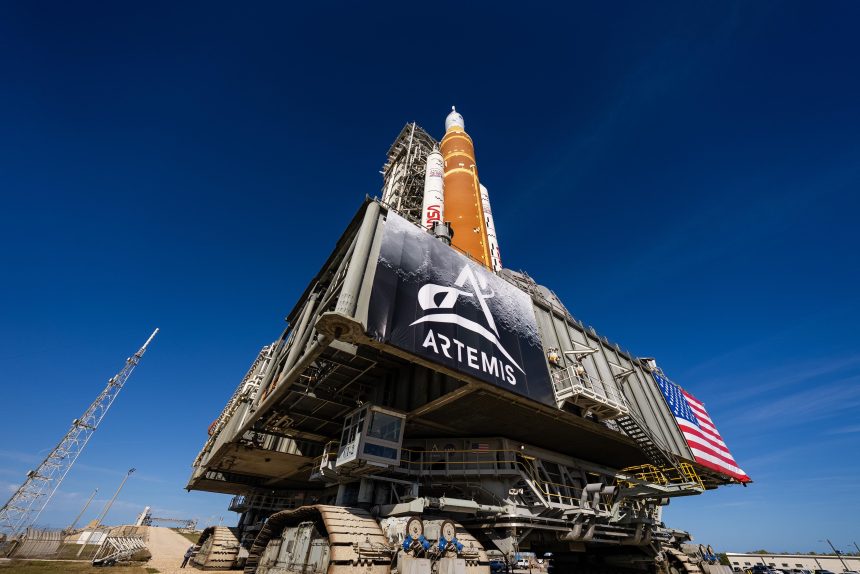
The mission began at Kennedy Space Center in Florida. The Space Launch System, with a core stage powered by four RS-25 engines and two solid rocket boosters, produced 8.8 million pounds of thrust at liftoff.
Launch is controlled combustion.
Within seconds of ignition, the vehicle cleared the tower and accelerated through the lower atmosphere, where structural stress peaked. The rocket crossed Max Q and throttled down briefly to protect the structure.
Nothing here was reactive. Every parameter was defined before ignition and executed automatically.
Ascent and Stage Separation
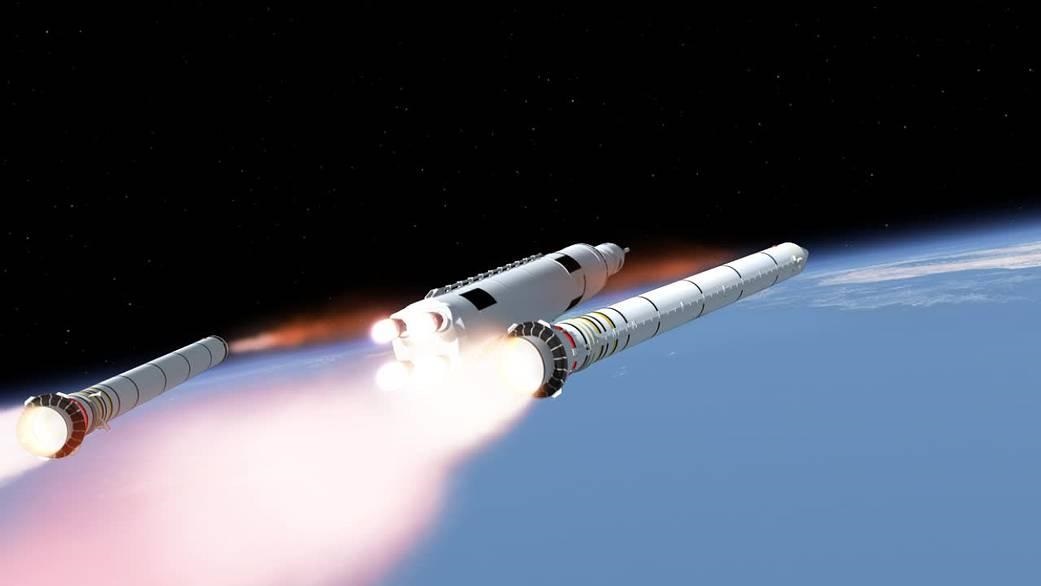
The solid rocket boosters detached roughly two minutes after launch. The core stage continued to burn, then separated, leaving the Orion spacecraft attached to the interim cryogenic propulsion stage.
Related Articles

This upper stage placed the spacecraft into a highly elliptical Earth orbit, positioning it for the next manoeuvre.
Separation was a moment of consequence. Timing and alignment had to be exact.
Earth Orbit and Translunar Injection
The spacecraft entered Earth orbit for system checks. The upper stage then performed the translunar injection burn, sending the Orion spacecraft towards the Moon at approximately 11 kilometres per second.
Small errors expanded across distance, often unnoticed until they became difficult to correct.
In space, a small mistake is patient. It waits, then multiplies.
Deep Space Transit and Lunar Flyby
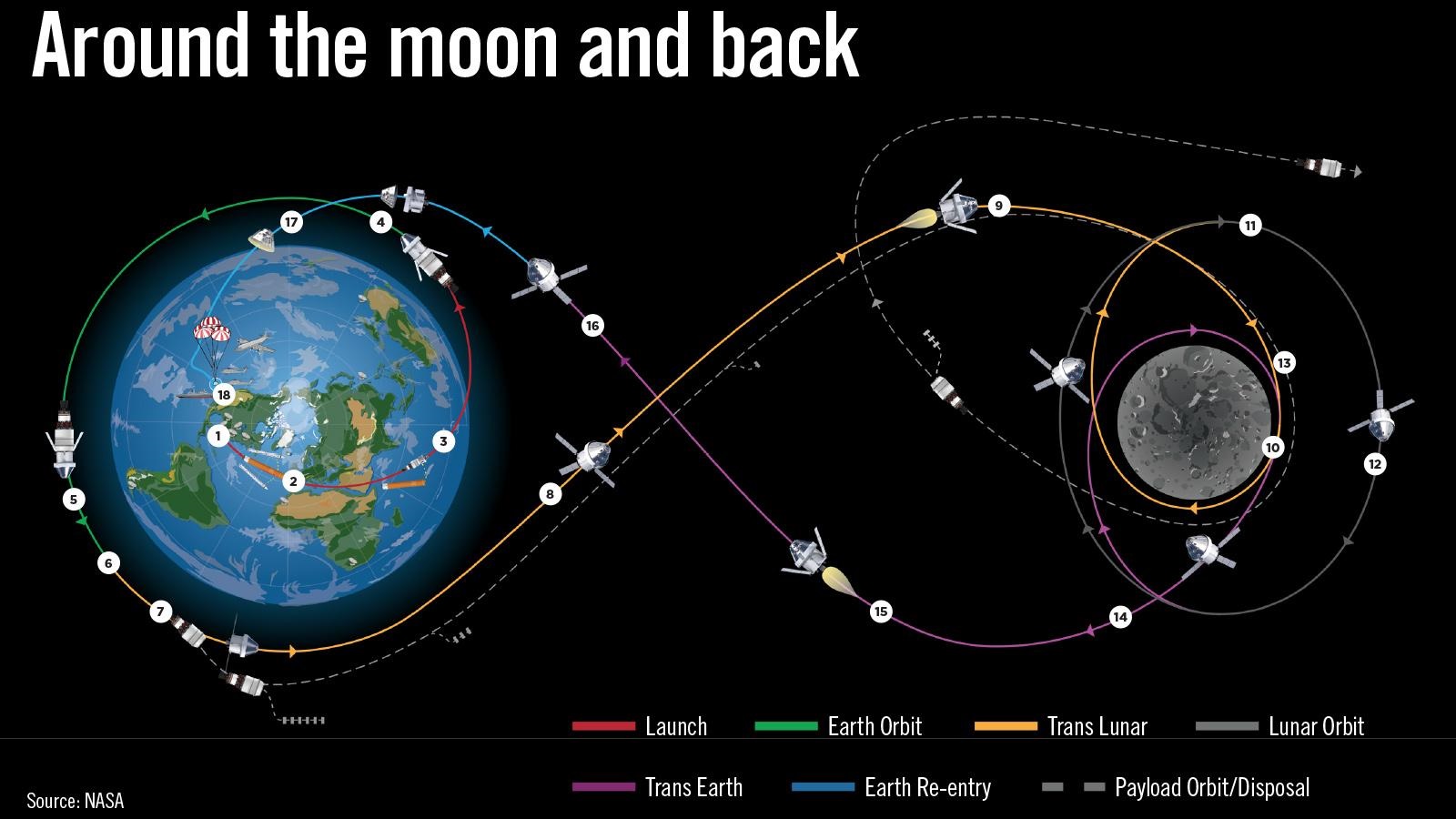
The Orion spacecraft moved beyond low Earth orbit into deep space, operating as a true deep space mission where radiation, isolation, and delay governed every decision.
Radiation in deep space is not comparable to low Earth orbit. Outside Earth’s magnetic shielding, the crew was exposed to higher levels of solar and cosmic radiation. Communication delay introduced a structural limit. Signals took seconds to travel, removing the possibility of real-time intervention from mission control. The crew became part of the decision system, not just its operators.
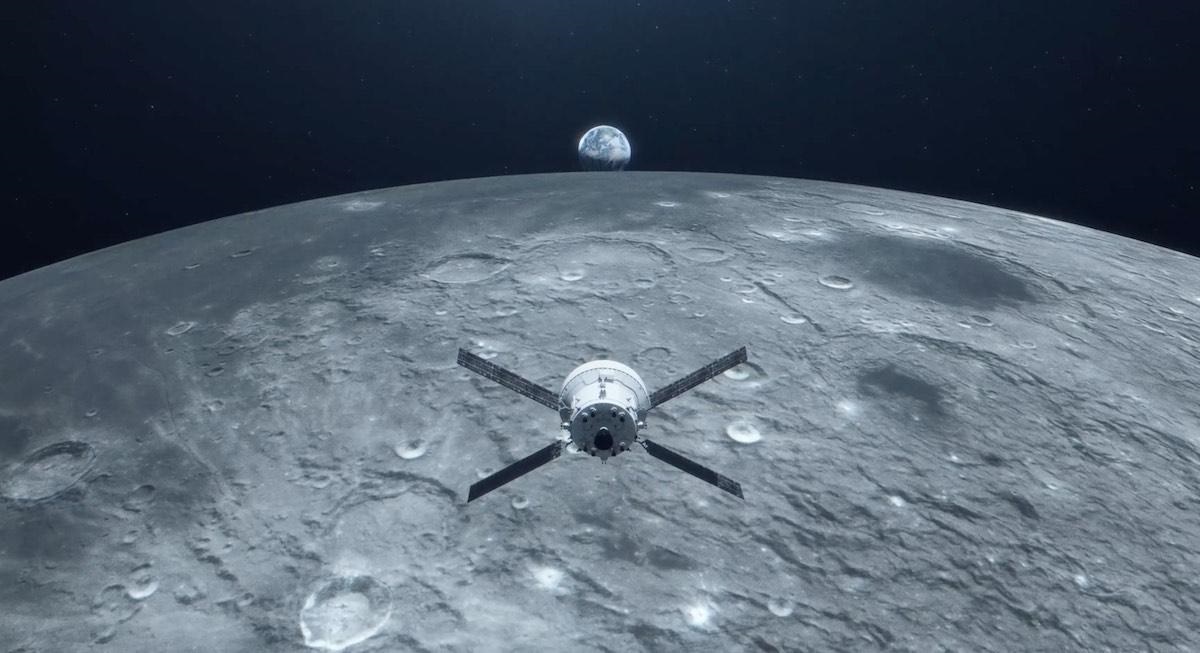
During this phase, the mission reached a maximum distance of approximately 406,771 kilometres from Earth, setting a new record for human spaceflight.
It performed a lunar flyby, using the Moon’s gravity to return to Earth on a free-return trajectory.
The free-return trajectory was not simply efficient. It was a design choice that embedded safety into physics. If propulsion failed at the right point, orbital mechanics carried the spacecraft back towards Earth. That design choice echoed the recovery path used during Apollo 13, where trajectory, not engines, became the primary means of survival.
What engineering could not guarantee, trajectory absorbed.
Re-entry and Splashdown
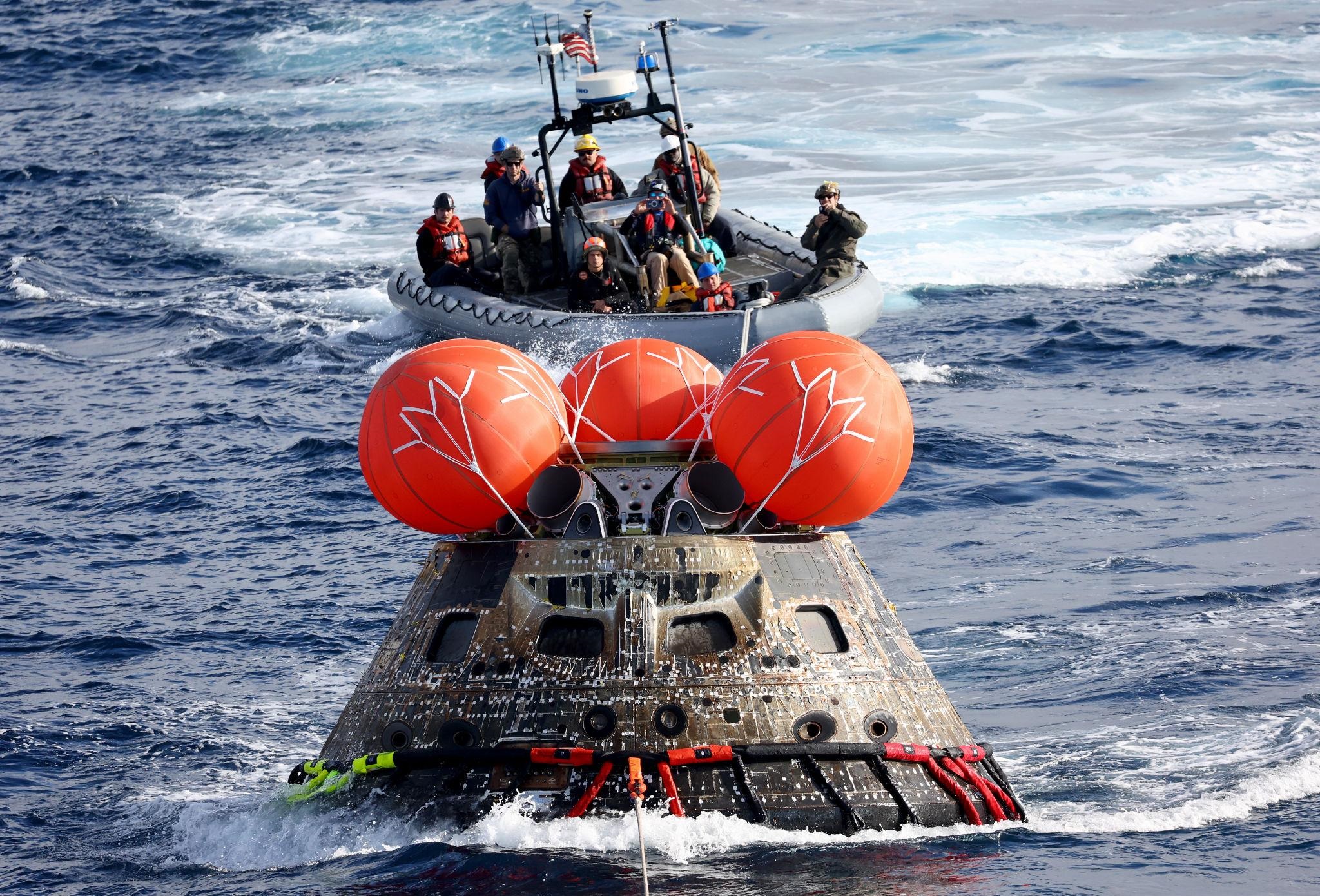
The Orion spacecraft re-entered Earth’s atmosphere at high speed using a steeper direct entry profile to manage heat and reduce the duration of peak thermal exposure. During re-entry, the spacecraft encountered temperatures of approximately 3,000 degrees Fahrenheit. Parachutes deployed in sequence, then the crew module descended to splashdown in the Pacific Ocean, completing the deep space mission.
Landing is an event. Recovery is a system.
Why It Is Designed This Way
Design choices here mirror how high-stakes systems on Earth are built, where failure is costly and recovery is not immediate.
The phases reflected trade-offs between safety, cost, and reliability. The free-return trajectory reduced risk by embedding a return path into the mission’s physics rather than relying solely on propulsion systems. The direct entry profile reduced the duration of peak thermal stress following heat shield performance observations from Artemis I. Ocean splashdown simplified recovery operations.
The system was not optimised for speed. It was built for survival and repeatability.
A faster mission would have been less forgiving. A simpler system would have been less reliable.
The Mission’s Real Objective
The Artemis II mission was not about reaching the Moon. It was about proving that humans could complete a deep space mission safely and repeatedly.
Launch did not define success. Integration did. Re-entry, trajectory alignment, and system coordination carried equal weight.
Space missions do not fail only in dramatic moments. They fail in small misalignments that compound.
Why It Matters
The Artemis II mission has defined how future deep space missions will be built. Not as isolated achievements, but as repeatable systems.
This affects more than space agencies. It shapes how humanity plans long-duration travel, governs remote operations, and allocates risk in extreme environments. In aviation, accident investigations show that disasters rarely result from a single failure. They emerge from small, compounding breakdowns across systems. Spaceflight has internalised that lesson in advance.
The mission also reflected how complex systems are now built across institutions. The Orion spacecraft relied on a European-built service module for propulsion, power, water, and life support. A deep space mission was no longer a single-agency effort. Across approximately 1,117,659 kilometres, it operated as a coordinated system of interdependent parts.
What begins in orbit often returns as infrastructure. The lessons of deep space design compound over decades.
The mission returned its answer.
What the Artemis II mission clarified is not only how humans travel to space, but how systems must be built when people depend on them under unforgiving conditions.
Four people travelled beyond low Earth orbit for the first time in over five decades, spent around ten days in Integrity, and returned.
Trust in a system is not declared. It is earned through repetition.
Spaceflight has changed its question. Not how far humanity can go once, but how consistently it can return.

