

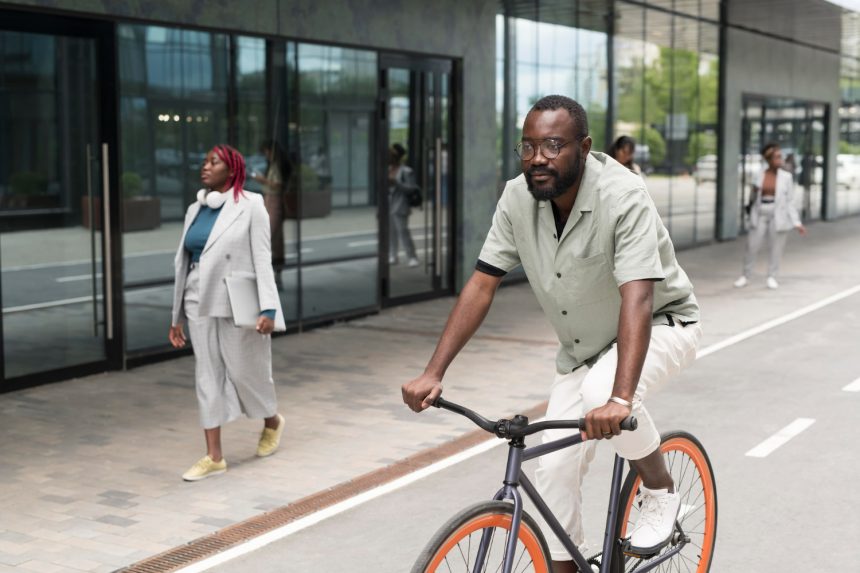
On an ordinary Saturday morning, what looked like a threat turned out to be grace, and I very nearly rode past it.
There is a particular quality to Saturday mornings that is difficult to describe unless you have lived inside one. The streets are quieter. The air feels less contested. In Lagos, where noise is not an interruption but a constant condition, Saturday mornings offer a brief window in which the city seems to exhale. It was on one such morning, cycling home from the gym with two hours of exercise behind me and a pleasant kind of tiredness in my legs, that a dog changed my life.
I had not thought much about the ride home. The route was familiar, the morning was cool, and my mind was in that easy, unhurried state that follows physical effort. I was not rushing anywhere. I was simply moving, pedalling through streets that were still finding their rhythm for the day. That steadiness, as it turned out, mattered. Slowness created space for awareness. Awareness, in that particular case, created space for survival. That was when the dog appeared.
It came from nowhere that I could identify. One moment the path ahead was clear, and the next there was a dog, planted squarely in front of me, barking with a kind of urgency that seemed entirely disproportionate to the moment. I looked left. I looked right. There was no obvious owner nearby, no gate that had been left open, no clue as to where this animal had come from or what it wanted.


My first instinct, as it would be for most people in that position, was alarm. A barking dog blocking a bicycle path is not an invitation to reflection. It is the kind of situation that narrows your thinking immediately. I slowed down, tried to move around it, and the dog moved with me, blocking my path again. I pressed forward. It stood firm. Then, as I attempted to ride past, it grabbed the hem of my trousers with its teeth and pulled.
The grip was firm enough to bring me off balance and force me to put my foot down. I stood there, half off my bicycle, looking at this animal that had effectively brought me to a stop, and I felt the particular mixture of fear and bewilderment that comes when you cannot make sense of what is happening in front of you. Was it aggressive? Was it playing? Was it simply a badly trained dog with no particular agenda beyond causing inconvenience?
And then the electric pole collapsed.
It fell directly across the road, perhaps three metres ahead of where I stood, the precise point I would have reached had I managed to ride past the dog a few seconds earlier. The sound it made as it hit the ground was sudden and final, the kind that stops all other thought. What had been an ordinary Saturday morning became something else entirely. What I had experienced as obstruction became, in a single second, protection. In a city where ageing infrastructure and unpredictable weather work against each other quietly and without warning, such things happen.

The dog had known. Somehow, in whatever way animals perceive the world around them, it had understood that something dangerous lay ahead on the path I was travelling. Its awareness extended further than mine. My field of perception reached only as far as the immediate road ahead. The dog had registered instability in the environment before I did, and it had done the only thing available to it. It had used its body, its voice, and eventually its teeth, to stop me from moving forward.
I stood there for a moment, genuinely shaken, and looked at the dog differently. It was watching me with what I can only describe as expectant calm, the kind of stillness that follows completed effort. I bent down and placed my hand gently on its side. It leaned into the gesture. The people nearby who had witnessed the scene, the few neighbours who had been out on their Saturday errands, had gathered quietly at some point during the commotion. I noticed them only now, and saw in their faces the same recognition that was settling in my own.
Shortly afterwards, the dog’s owner appeared. A young woman who apologised instinctively for the disruption her dog had caused. I thanked her. I thanked her with a warmth that I suspect surprised her, because she did not yet know what had just happened. I tried to explain, and she listened, and her expression shifted from puzzlement to something quieter and more serious.
I have thought about that morning many times since. Not obsessively, but with the recurring attention we give to experiences that genuinely mark us. What stays with me is not the drama of the falling pole or the near miss itself, though those details remain vivid. What stays with me is the lesson embedded in the sequence of events, and how easily I might have missed it entirely.
We tend to imagine that help arrives in forms we will recognise. We picture it as the right person appearing at the right time, saying exactly what needs to be said. We imagine it as a friend’s phone call, a stranger’s well-timed advice, a door opening where we expected none. What we do not always account for is the possibility that help might arrive looking exactly like trouble.
I have spent enough years in business to understand this more than I once did. There have been partnerships that dissolved at the final stage, contracts that came apart without clear explanation, opportunities that vanished just as they seemed certain. Each felt like a setback at the time. In retrospect, some of those disappearances shielded me from misaligned ventures, unstable arrangements, or exposure that would have been far more damaging. What I had labelled obstruction was, in several cases, protection arriving without introduction. I simply lacked the visibility to see what lay on the other side of the path I was determined to travel. Of course, not all resistance is protective. Some is consequence. Some is misjudgement, and must be recognised and corrected. But a disciplined life includes the capacity to distinguish between the two.
That distinction begins with honesty about our limitations. We operate with partial information. We see as far as the immediate road ahead. But reality extends beyond our field of vision, and what intervenes sometimes perceives that further terrain more clearly than we do. We are often determined to move forward because we mistake momentum for wisdom. The more considered response to obstruction is not always to push through it. Sometimes it is to pause, to observe, to ask what it might be preventing.

The deeper difficulty is psychological. When something blocks us, we tend to interpret it through the lens of intent. The delayed contract is someone working against us. The missed opportunity is the market failing us. The cancelled meeting is a signal of disrespect. We assign meaning and motive to what is, frequently, simply incomplete information. The dog was not hostile. It had no agenda concerning me personally. It was responding to something real in the environment. My error was to read its behaviour through the assumption of opposition rather than the possibility of perception.
The dog did not look like salvation. It looked like an obstacle, an aggressive animal, an interruption to a perfectly pleasant morning. Everything about the encounter, read through ordinary assumptions, pointed towards threat rather than grace. And yet it was grace, as direct and practical and unambiguous as grace can be.
Care, in whatever form one believes it operates, is not restricted to the familiar. It does not only arrive through the people we know, the channels we recognise, the circumstances we have anticipated. It may come through an animal. Through an unexplained delay. Through a refusal that seems, in the moment, entirely unreasonable. If we are only able to receive help when it arrives in the forms we expect, we will miss a great deal of what is offered to us.
I left that street with the kind of gratitude that goes beyond good manners. It was the gratitude of someone who has been reminded that the world contains more care than is immediately visible, and that this care does not always speak in languages we have been taught to understand. Gratitude of that quality does not always arrive on schedule. In many situations, the pole does not fall within view. The danger avoided remains hypothetical, the connection between obstruction and protection never confirmed. That is where a certain kind of attentiveness becomes essential, the willingness to look back across the detours and ask, in earnest, what some of them might have preserved.
Sometimes it barks. Sometimes it grabs your trouser leg. Sometimes it holds you in place until the danger has passed.
That Saturday morning, it did all three. And I am glad I was stopped.