




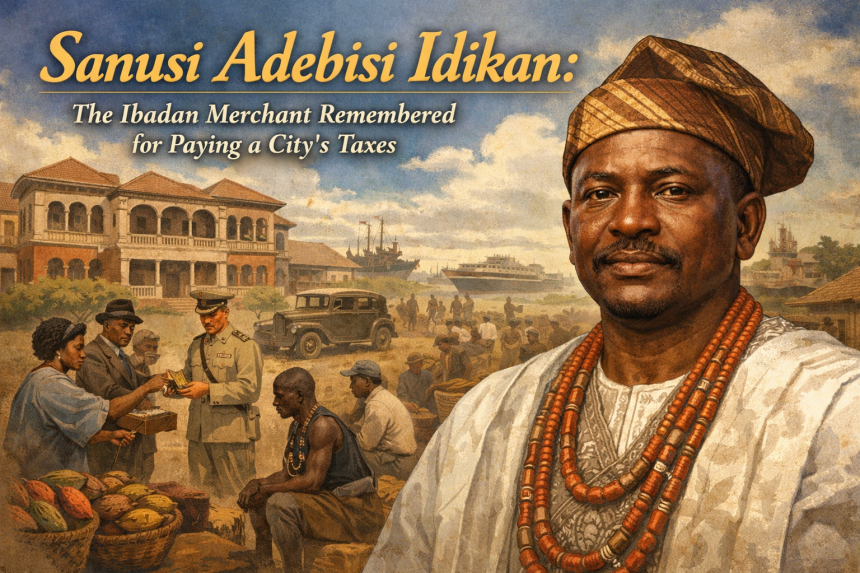
In the landscape of Nigerian business history, certain figures emerge not merely for their wealth but for how they chose to wield it. Sanusi Adebisi Idikan, who lived from 1882 to 1938, belongs to this rare category. His story illuminates something fundamental about the relationship between prosperity and obligation, particularly in contexts where colonial economic structures created new forms of social pressure that traditional communities were ill-equipped to manage.
The most striking account of Adebisi’s life is also the most difficult to confirm in its full scope: the persistent oral tradition in Ibadan that he paid taxes on behalf of the city’s entire taxable adult population. No colonial tax ledger has been produced to verify this in its totality, and the claim exists primarily in cultural memory and local historical accounts. What matters is that the story has endured across generations, suggesting something true about both the man and the moment, even where specific details resist verification.
Origins and Early Commerce
Adebisi was born in Ibadan during the reign of Aare Latoosa, when the city had established itself as arguably the most cosmopolitan urban centre in West Africa. His father, Adesina, had migrated from Efon Alaaye in what is now Ondo State, working as an itinerant weaver of Ofi cloth, the traditional Yoruba fabric reserved for ceremonies and significant life events. According to oral accounts, Adesina also served as spiritual consultant to Alaafin Atiba, a connection that reputedly brought both prestige and personal reward, including Atiba’s betrothal of his daughter, Princess Ogboja, to Adesina. These details are rooted in oral tradition rather than written colonial record, and should be understood as such.
Adebisi, the youngest of three children, began by hawking his father’s cloth alongside his siblings. What distinguished him was not exceptional talent at the outset but methodical expansion. Before turning eighteen, he had extended the business beyond Ibadan to Iwo, Ile Ogbo, Ikire, Oshogbo, Ife, Ondo, and eventually Benin. This geographic spread required not just ambition but an understanding of logistics, credit relationships, and regional demand patterns that most traders never developed. His success allowed him to retire his significantly older siblings from the business, a reversal of typical family hierarchy that suggests both his commercial dominance and his ability to navigate potentially difficult family dynamics without apparent conflict.



The Cocoa Economy
Cocoa had been introduced to Nigeria in the 1870s, with the earliest farms in Bonny and Calabar, and cultivation subsequently spreading through the Yoruba hinterland. By the 1890s, farmers in Ibadan and surrounding areas had begun experimenting with the crop, and it had established itself as the region’s premier cash crop within a generation. Adebisi’s entry into cocoa farming represented a transition from trading to production, from moving goods to creating them. He developed a substantial plantation in Ashipa village in Mamu, constructing not just farm infrastructure but housing for workers, creating what amounted to a self-contained economic unit.
The success of the Mamu plantation encouraged further expansion. He acquired approximately 200 acres in Apata, Ibadan, according to local historical accounts, establishing another cocoa operation. That land is today associated with the NNPC depot in the area. This dual-plantation model provided both diversification and scale, insulating him somewhat from localised crop failures or market disruptions whilst generating the volume necessary for serious wealth accumulation.
His standing among cocoa merchants led to his appointment as Giwa Egbe, head of the merchants’ society that included other prominent traders such as Otiti, Ekolo, Afunleyin, and Ladimeji from Isale Ijebu. The title was not merely honorific. It represented recognition from peers that he could be trusted to navigate the complex relationships between indigenous merchants and the increasingly dominant European trading companies operating across the region.
The Miller Brothers Partnership
Around 1920, representatives of the Miller Brothers company from the United Kingdom arrived in Ibadan seeking local business partners. Miller Brothers was already an established West African trading firm, and they required someone who combined substantial capital, established networks, and the ability to manage complex distribution operations. Despite being unlettered, Adebisi maintained secretaries and personal assistants who handled written documentation, allowing him to operate effectively in an increasingly bureaucratic commercial environment.



The Miller Brothers appointed him as their factor, making him the primary distributor for goods imported through their Nigerian operations. Ibadan served as the main depot, and Adebisi controlled how products moved through regional markets. This relationship proved transformative for both parties. Miller Brothers subsequently became a constituent company of the African and Eastern Trade Corporation, which in turn merged with the Niger Company in 1929 to form the United Africa Company. UAC became one of West Africa’s dominant commercial entities over the following decades, and Adebisi’s early association with the enterprise contributed significantly to his accumulating wealth.
The Tax Crisis
The colonial government’s imposition of mandatory taxation on all male adults created a profound social crisis in Ibadan. Most residents were subsistence farmers whose economic lives revolved around survival rather than cash accumulation. The colonial tax regime, designed for a monetised economy, intersected catastrophically with a largely non-monetary agricultural system.
Tax defaulters were held at the Mapo Hill administrative precinct, which served as the colonial treasury office and a detention point for those unable to pay. The broader Mapo area, which would later become the site of the now-famous Mapo Hall built between 1925 and 1929, had long served Ibadan’s administrative functions, and its association with tax enforcement was well established in the collective memory of the city’s residents. The mini-museum within Mapo Hall still displays the chains used to hold tax evaders during the colonial era.
The detention system created a paradox: those unable to pay taxes were held, but those who might assist them were typically themselves in arrears. Local oral history holds that a Balogun of Ibadan, Balogun Ola, son of Baale Orowusi, took his own life in protest at the conditions facing Ibadan’s young men. This account, repeated across Ibadan’s oral tradition, is not confirmed in written colonial records, and must be understood as cultural memory rather than documented fact. What is clear is that the community responded to the story meaningfully, naming him Kobomoje, which translates roughly as one who displayed courage against fear.
Tax payment transformed into social marker. A song emerged mocking defaulters: “Owo ori ti d’ode o, o o’ode o baba wa loko san,” which translates to “payment of taxation has come, our fathers were the first to pay, the idiots and lazy ones who have not paid are in detention in Mapo.”
Adebisi’s Intervention
Adebisi’s response to this crisis revealed something about his conception of wealth’s purpose. As one of Ibadan’s earliest car owners, he travelled to the colonial tax office at Mapo, accompanied by his horse dispatch rider, Ladimeji, who rode ahead of the vehicle for effect. At the colonial tax office, he made an extraordinary proposal: he would pay taxes on behalf of taxable adults in Ibadan. The colonial officer questioned whether Adebisi understood the financial implications. He persisted. Thereafter, according to local accounts, the officer would calculate the expected tax revenue and collect the full amount from Adebisi’s residence.
This arrangement requires careful interpretation. Oral tradition presents it as universal, covering all of Ibadan’s taxable adults, though no colonial record has been produced to confirm this scope. What appears well established is that his interventions were substantial enough to relieve significant community burden and to generate a reputation that persists to this day.

His reported philosophy, “the rich must help the poor who are vulnerable,” suggests awareness that his wealth derived in part from the same rapidly monetising colonial economy that had placed subsistence farmers under impossible financial pressure. The tax payments can be understood as a form of structural compensation, redistributing returns from that monetised economy to those trapped outside it.
Additional Philanthropic Patterns
Adebisi’s approach to debt forgiveness followed a distinctive pattern. He would instruct his secretary, Adesokan, to read aloud the names of debtors and their outstanding amounts. He would then tear the papers and burn them with a matchstick, saying “nobody likes to be a debtor.” This performative destruction of debt records served multiple functions: it eliminated the obligation, prevented future claims, and demonstrated that wealth could be wielded without perpetual leverage over those indebted to it.
On one occasion, returning from a visit to the Timi of Ede, he encountered a handcuffed debtor being escorted to Agodi prison. After learning the man’s offence, Adebisi paid the debt and secured his release. The freed man reportedly refused to leave Adebisi’s household, insisting he would remain as one of his workers. This story, repeated in various forms across accounts of his life, illustrates how Adebisi’s generosity created structures of attachment that, whilst voluntary, nonetheless bound recipients through gratitude and loyalty.
Political Ascent
On 26 November 1926, Adebisi was installed as Ashaju Baale of Ibadan, jumping approximately ten positions in the Otun Olubadan civil hierarchy. This accelerated rise reflected his economic standing, though it also generated tensions with those who had been bypassed according to traditional progression. By 1936, he had risen to Ashipa, installed by Olubadan Abass Okunola Aleshinloye, who was both his close friend and father-in-law. Personal relationships and economic standing had become as significant as conventional criteria in determining political advancement.
Local accounts also indicate that he served in a judicial and land dispute capacity in 1936, though the precise title associated with this role is not confirmed in available colonial administrative records. Given the intense pressure that cocoa expansion was placing on available farmland at the time, such a position would have placed him at the centre of economic conflicts with lasting consequences for Ibadan’s development.
Final Days
Experiencing declining health, Adebisi consulted Dr Doherty, a surgeon in Lagos. Advised to remain in Lagos for several weeks to reduce stress, he purchased a house at 34 Whitman Street, Ebute Meta, rather than seek temporary accommodation. Even recuperation required property ownership, reflecting both his wealth and his instinct to establish permanent presence wherever he spent significant time.
In his final months, he continued his pattern of debt forgiveness, bringing out papers containing debtors’ names and amounts, tearing and burning them without apparent premonition of what was to come. He died on 21 June 1938, at fifty-six years of age.
Legacy and Interpretation
An Ibadan proverb captures the comparative reputation of the era’s two wealthiest men: “Ile Adebisi lati je Malu tawo tawo, awa o je dodo, nile Salami,” meaning “it is in Adebisi’s house that cow meat is eaten wholly with its skin, whilst we have not eaten fried plantain in the house of Salami.” Salami Agbaje, Adebisi’s contemporary and the other leading merchant of the period, chose to invest his wealth primarily in his children’s education, producing Ibadan’s first trained physician and lawyers. Adebisi chose conspicuous generosity directed outward toward the community.
Neither approach was objectively superior, though the contrast illuminates different conceptions of wealth’s purpose. Salami built human capital within his lineage. Adebisi built social capital across the community. Both strategies proved effective, though they produced different forms of remembrance.
Adebisi’s 99-room mansion in Idikan, built in 1929, still stands as architectural testimony to his wealth and ambition. The structure, comparable in local estimation to Mapo Hall itself, represented not just personal residence but a statement about indigenous capacity for monumental construction during the colonial period. That it remains occupied by descendants suggests both the durability of his legacy and the ongoing significance of his name within Ibadan’s historical consciousness.
Questions That Remain
The historical record leaves certain questions unresolved. Did Adebisi actually pay taxes for all of Ibadan, or did the account grow through repeated telling into something larger than the original act? How did his various philanthropic gestures affect Ibadan’s broader economic development compared to strategies focused on education or infrastructure? These gaps matter because they prevent the story from becoming simple morality tale.
What remains clear is that Adebisi recognised something fundamental: within a rapidly monetising colonial economy, the obligations of wealth were not discharged merely through personal accumulation. His tax payments, debt forgiveness, and conspicuous generosity represented a sophisticated understanding of how power operates in communities where traditional reciprocity structures collide with externally imposed economic demands.
The fact that his story persists across generations, retold with consistent emotional conviction, suggests that Ibadan recognised something worth preserving in his approach. In a city that produced many wealthy men, he remains remembered not for what he accumulated but for what he chose to give away.
A Note on Sources
Much of Sanusi Adebisi Idikan’s life is preserved through Ibadan’s oral tradition. Where written historical scholarship exists to support specific claims, it has informed this account. Where sources rely on oral history, this has been indicated in the text.
Further Reading
For readers who wish to explore the historical and economic context of this account in greater depth, the following works are recommended.
- Berry, Sara. Cocoa, Custom, and Socio-Economic Change in Rural Western Nigeria. Oxford University Press, 1975. A foundational study of cocoa’s role in reshaping Yoruba economic and social life.
- Fieldhouse, D.K. Unilever Overseas: The Anatomy of a Multinational, 1895–1965. Hoover Institution Press, 1978. Traces the corporate evolution of UAC and its constituent firms including Miller Brothers.
- Falola, Toyin. Colonialism and Violence in Nigeria. Indiana University Press, 2009. Examines how colonial economic structures, including taxation, shaped Nigerian communities.
- Hopkins, A.G. An Economic History of West Africa. Longman, 1973. The standard reference on West African economic development through the colonial era.
- Smith, R.S. Kingdoms of the Yoruba. 3rd ed., University of Wisconsin Press, 1988. The authoritative account of Yoruba political structures, including Ibadan’s chieftaincy hierarchy.