




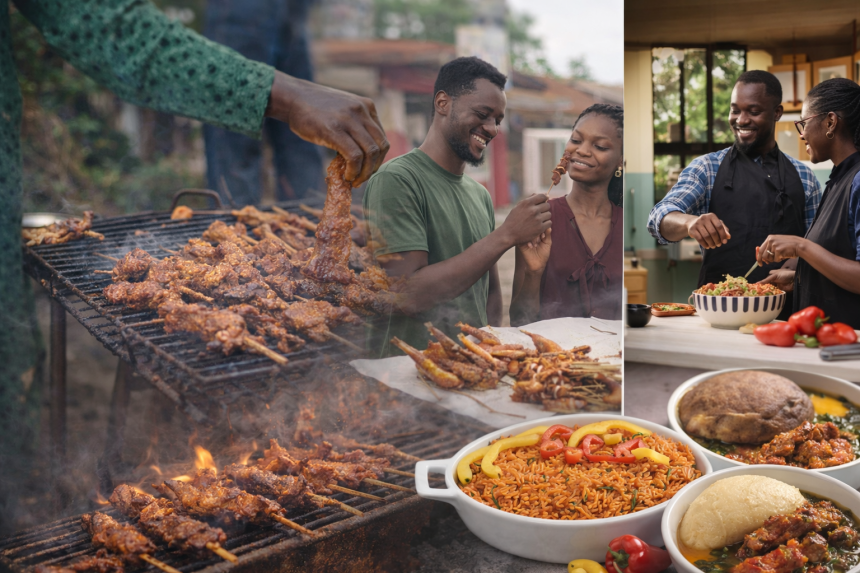
The choice between home-cooked meals and street or restaurant food has never been purely about hunger. In Lagos and across Nigeria, it is a daily negotiation between identity, economy, and the pace of modern life.
Home-cooked food carries a particular kind of authority. Not in flavour alone, though Nigerians will argue that point passionately, but in what the act of cooking at home represents: time invested, care exercised, and a domestic order that still holds. When that order loosens, as it does in a city like Lagos, where the commute alone can consume four hours of a person’s day, the roadside vendor steps in. And the roadside vendor has become a defining figure in Nigerian urban life.
The question of whether to eat at home or outside is not answered the same way twice. It shifts with income, with the day of the week, with whether the gas cylinder is empty. But the pattern of how people answer it, repeated across millions of households, reveals something honest about how modern Nigerian life is actually arranged, not how it is assumed to work.
The Home Kitchen as Cultural Anchor
For most Nigerian families, cooking at home has never been a lifestyle choice. It remained the default, shaped by tradition, economy, and the structural expectation that the household cook would manage it. Yoruba households in Lagos have long organised domestic life around the kitchen: egusi ground fresh, stew fried low and slow, pots carried between families during celebrations. The home kitchen was not merely functional. It was where recipes passed between generations, where a child learned to distinguish the smell of overcooked ogiri from the correct depth of its ferment.
That transfer ran deeper than the culinary. It sustained cultural continuity through daily practice. What food you prepared at home, and how you prepared it, announced your ethnic origin, your social standing, and your sense of what it meant to care for people properly. A pot of well-made okra soup in a Lagos home is not simply dinner. It is a statement. Care, in this context, is not sentiment. It is labour organised over time.


The challenge is that maintaining that statement has grown steadily more demanding. Lagos markets require early mornings, sustained attention, and the kind of physical negotiation that a nine-to-five worker returning at eight in the evening cannot reasonably offer. The ingredients are available. The knowledge, in many households, still exists. The hours do not. The barrier to consistent home cooking in urban Nigeria is not ignorance of what to cook. It is the structural impossibility of finding time to cook it.
What the Street Offers That a Kitchen Cannot
Street food in Nigeria is not a compromise. That framing misunderstands it completely. Suya sold near midnight on Allen Avenue carries a social function that no home kitchen replicates. Ewa agoyin eaten at the corner of a Lagos bus stop at six in the morning is not a failure of domestic organisation. It is a ritual, one that connects the buyer to something communal and immediate in a city that otherwise fragments and isolates.
Across Nigeria, street food functions as a marker of culture, location, and social belonging. Nowhere is this more apparent than in Lagos, where the commercial density of the city has produced one of the most layered street food cultures on the continent. The vendor who has occupied the same roadside spot for fifteen years is not simply selling food. She provides a consistent point of reference in an environment defined by noise and constant change.
Taste compounds the argument. Street food produces flavours that home kitchens cannot replicate, not because the ingredients differ but because the method does: the coal fire, the open grill, the accumulated seasoning of a pan used daily for years.


Consider party jollof rice, cooked in large pots over wood fire, slightly burnt at the base for that coveted smoky flavour. It differs entirely from home-style jollof, and every Nigerian who has eaten both understands the distinction without needing any explanation. That difference is not accidental. It is the product of a cooking context, a social occasion, a scale of production that changes the food itself. The gap is not merely technical. It is cultural distance, measured in fire, smoke, and accumulated daily practice that no domestic kitchen can replicate on demand.
Street food also solves an economic problem that home cooking cannot address. Buying ingredients in bulk, managing storage, and running a kitchen assumes a financial stability that many Lagos households do not consistently hold. Street food aligns with irregular income. It requires no planning, no upfront spending, and no functioning utility. You pay for exactly what you need, when you need it. That flexibility is not a minor convenience. For a significant portion of the city, it is the difference between eating and not eating. Affordability is not the same as accessibility.
The Restaurant as a New Social Space
Between the home kitchen and the roadside stall, a third territory has expanded significantly: the Lagos restaurant. It would be a mistake to treat restaurants and street food as the same category. They serve overlapping practical needs but carry different social weights.
The restaurant in Lagos has become, particularly since the early 2010s, a site of middle-class aspiration and public identity. Going out to eat is not simply about food. It is about being seen eating out, about the leisure implied by that choice, and about participation in a consumer culture that signals a particular kind of arrival. What appears as leisure often doubles as language. The emergence of amala joints that attract corporate professionals alongside market traders, or eateries in Lekki where the clientele photograph their food before eating it, exposes how food choices now function as instruments of self-presentation in urban Nigeria.
That connection between eating and self-presentation deserves honest examination. When restaurant eating is chosen not because the food is better or more convenient but because the setting communicates a desired social position, the meal has become a performance. The food itself, in that context, is almost incidental. What is being consumed is the occasion. Nothing is wrong with that, but it shifts what food means. The nutritional and emotional value of eating recedes behind the social grammar of where and how one is seen to eat.
What the Pattern Reveals
The increasing dominance of street and restaurant food in urban Nigerian life is not, at its core, a story about convenience. It is a story about time, about how the structural demands of city living have reorganised domestic priorities, and about what survives that reorganisation and what quietly disappears.
In a city as fast-paced as Lagos, buying food outside has become, for many, a survival mechanism rather than a preference. Survival mechanisms, repeated consistently enough, become culture. What began as a practical response to the Lagos schedule has produced a generation of urban Nigerians for whom eating outside is a primary relationship with food, not an occasional one.
Home cooking has not disappeared. It remains the standard for Sunday meals, for family gatherings, for the food sent to a new mother or a bereaved household. Its ceremonial authority is intact. What has shifted is its everyday authority, its role in an ordinary Tuesday, in the midweek lunch, in the exhausted weeknight dinner. Those occasions belong increasingly to the street and the restaurant.
That shift carries implications that extend beyond what ends up on the plate. The domestic knowledge embedded in home cooking, the recipe passed by watching rather than written down, the technique calibrated by smell rather than timer, erodes when cooking happens less frequently. A generation that eats out most days learns to consume food but not necessarily to produce it. Loss here is quiet. It rarely announces itself. The health consequences deserve naming directly. Rising rates of hypertension, obesity, and metabolic disorders in Nigerian urban centres are linked, in part, to a sustained pattern of meals built for speed and taste rather than nutritional balance. No single plate is the cause. The pattern, sustained across years, is.
The question of what cooking represents beyond nutrition remains unsettled in Nigerian households. In Lagos, it is renegotiated every evening, between the person who stopped at the ewa agoyin seller on the way home and the one who put a pot on the stove. That negotiation is not simply about food. It is about what kind of city this is becoming, and what it costs to live in it.