





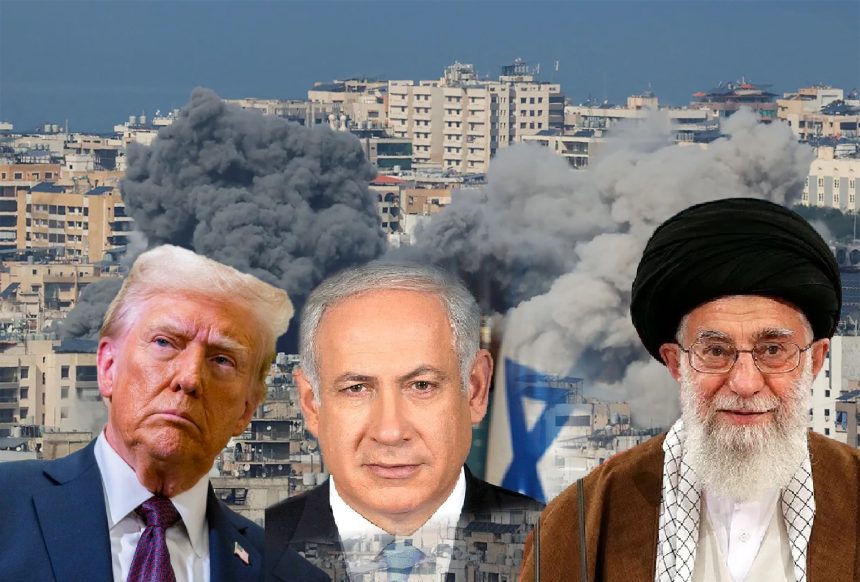
The killing of a head of state in his own capital, the effective blockage of the world’s most critical energy corridor, and the targeting of twelve sovereign nations by a single expanding military campaign: these are not events that arrive with clean moral ledgers. They arrive with consequences that will take years to fully price.
On 28 February 2026, the United States and Israel launched coordinated military strikes on Iran, codenamed Operation Epic Fury and Operation Roaring Lion respectively. The stated objectives were the elimination of Iran’s nuclear programme, the destruction of its naval and ballistic missile capabilities, and the removal of its ruling leadership. What has followed is not a contained operation. It is a regional war, now in its sixth day, with the death toll accelerating, the US Senate already on record on the question of its legality, and no discernible path to an exit that resembles the outcome either Washington or Jerusalem described.
The Road That Led Here
Wars rarely begin on the day the first missiles launch. They begin years earlier, in decisions that quietly narrow the number of remaining alternatives.
To understand what began on 28 February, the timeline cannot start there. It starts in October 2023.



The Hamas attacks on Israel that month, and the Gaza war that followed, set in motion a sustained Israeli campaign to dismantle Iran’s regional network of armed proxies. Hamas in Gaza and Hezbollah in Lebanon, the two most powerful instruments of Iranian forward deterrence, were both severely degraded over the subsequent two years. The Assad government in Syria, a long-standing Iranian ally, fell to rebel forces in December 2024. Iran’s Axis of Resistance, the strategic architecture it had spent decades constructing, contracted sharply.
The confrontation between these parties was, of course, not new in 2023. For more than a decade before October of that year, it had unfolded through indirect means. In January 2020, the United States assassinated Iranian General Qasem Soleimani in Baghdad. The killing shocked the region, triggered Iranian missile retaliation against American bases in Iraq, and demonstrated how rapidly the shadow conflict could approach the threshold of open war. Throughout the early 2020s, nuclear facilities in Iran were sabotaged. Maritime incidents multiplied in the Gulf. Israel conducted repeated air strikes against Iranian-linked targets in Syria. Intelligence agencies on all sides pursued clandestine operations aimed at degrading the strategic posture of their adversaries. The shadow conflict lasted more than a decade. It ended on 28 February 2026.
During this period, Iran and Israel also exchanged direct strikes for the first time in their histories. In April 2024, a suspected Israeli strike on an Iranian consular building in Damascus killed two IRGC generals and five military advisers. Iran retaliated with over three hundred drone and missile attacks, the first time it had directly targeted Israeli territory. In October 2024, following the killing of Hamas and Hezbollah’s respective leadership, Iran launched around 200 ballistic missiles at Israel. Israel then struck Iran’s air defences and missile production facilities in its largest direct attack to that point.
By mid-2025, the two countries were engaged in what analysts described as the Twelve-Day War. Israeli forces struck Iranian nuclear and missile installations on 13 June. Iran responded with waves of ballistic missiles and armed drones. On 22 June, the United States conducted direct strikes on Iranian nuclear facilities at Natanz, Fordow, and Isfahan. A ceasefire followed on 24 June. The strikes degraded Iran’s defences and nuclear infrastructure, but they did not end the confrontation. They accelerated it.


Iran’s domestic situation compounded the pressure. Beginning in late December 2025, massive nationwide protests erupted across more than 100 Iranian cities, driven by economic crisis, the collapse of the rial, and rising prices. The Iranian government responded with violent repression. Casualty estimates vary sharply: the US-based Human Rights Activists News Agency put the death toll at 7,000, Iranian authorities acknowledged 3,117, and President Trump cited a figure of 32,000. In January 2026, Trump publicly declared that “help is on the way.” The Iranian government was simultaneously weakened from within and confronted from without.
A final diplomatic path was attempted. Indirect talks mediated by Oman, and a second round in Geneva, sought to address Iran’s nuclear enrichment programme. Those talks ran through three rounds: Oman on 6 February, Geneva on 17 February, and Geneva again on 26 February, two days before the strikes. The third round ended without a deal, principally over the US demand that Iran end all nuclear enrichment activity and resolve the question of its ballistic missile programme, though both sides agreed to meet again at a technical level in Vienna the following week. Within days, the United States deployed its largest military concentration in the Middle East since the 2003 invasion of Iraq. The trajectory was no longer ambiguous.
On 25 February 2026, Iranian Foreign Minister Abbas Araghchi stated that a “historic” agreement with the United States might be within reach. Three days later, the bombs were falling on Tehran.
What the Strikes Did
The scale of the opening operations exceeded anything seen in the region for decades. Israel’s air force dropped more than 1,200 munitions across 24 of Iran’s 31 provinces in a single day, attacking during morning hours rather than at night to maximise tactical surprise. The newly developed Black Sparrow air-launched ballistic missiles, fired from Israeli F-15s, were deployed for the first time. Combined with American strikes, around 2,000 targets were hit by 1 March. US B-2 stealth bombers, armed with 2,000-lb bombs, struck Iran’s ballistic missile facilities on the first night.
The operation’s most significant action was the assassination of Supreme Leader Ali Khamenei, killed when his compound in Tehran was destroyed. Also killed were Ali Shamkhani, Secretary of Iran’s Defence Council and close adviser to Khamenei, the army chief of staff, the defence minister, and multiple IRGC commanders. Iran established a three-person temporary leadership council, the Interim Leadership Council, to govern under Islamic law while a panel of Shia clerics selects a new supreme leader.
Beyond leadership targets, the strikes levelled the Expediency Discernment Council building in Tehran, destroyed the headquarters of the Islamic Republic of Iran Broadcasting, Iran’s state broadcaster, and targeted Iran’s parliament. The IDF also reported striking what it identified as a secret nuclear weapons development facility in the capital. By day five, Israeli forces had destroyed 300 Iranian missile launchers, according to the IDF’s own account.
In southern Iran, Bushehr International Airport was struck in a precision attack that destroyed an Iran Air Airbus A319 on the tarmac and caused significant structural damage to the terminal. The proximity of those strikes to the Bushehr Nuclear Power Plant prompted the Russian state nuclear agency Rosatom to suspend construction on new units and evacuate non-essential staff, citing loss of communication with Iranian officials.



Satellite imagery released on 3 March confirmed fresh damage to the Natanz Nuclear Facility. The IAEA stated on 2 March that it had found no evidence of damage to nuclear installations, though Iran disputed this and subsequent imagery contradicted the initial assessment.
Iran had been anticipating the strikes. It ramped up oil exports to multi-year highs in February, and Gulf states had been front-loading their energy supplies. The pre-positioning did not prevent the military catastrophe, but it softened some of the immediate economic shock.
Iran’s Response
Iran’s retaliation arrived within hours and spread across the entire region. The Islamic Revolutionary Guard Corps launched strikes on 27 bases in the Middle East where US troops are deployed, as well as Israeli military facilities across Israel. Missiles and armed drones struck targets in Bahrain, Iraq, Jordan, Kuwait, Oman, Qatar, Saudi Arabia, and the United Arab Emirates. An Iranian drone struck a runway at a UK military base in Cyprus.
In Israel, at least 40 buildings in Tel Aviv were damaged. An Iranian ballistic missile strike on central Israel’s Beit Shemesh killed nine people and injured more than 20. Hezbollah, despite a 2024 ceasefire agreement, launched rockets and drones at a military base near Haifa. By 4 March, Israeli strikes on Lebanon in retaliation had killed at least 77 people and wounded over 335, with 83,847 people displaced.
The US Navy’s 5th Fleet headquarters in Bahrain’s Juffair area was struck directly, and repeatedly. Bahrain’s international airport was hit by a drone. The US-flagged oil tanker Stena Imperative was struck in the Port of Bahrain, forcing crew evacuation. In Kuwait, four US service members from the 103rd Sustainment Command were killed in an Iranian retaliatory strike on a military facility, bringing the confirmed American death toll to six. At least two Kuwaiti service members were killed separately. A girl died in Kuwait from shrapnel injuries, bringing civilian deaths in that country to at least three.
Qatar’s Al Udeid military base, housing major US forces, was struck by two Iranian ballistic missiles. Qatar grounded all Qatar Airways flights, suspended air navigation indefinitely, moved all schools to remote learning, and cancelled public Ramadan gatherings. Qatar also arrested ten people suspected of operating as IRGC intelligence agents on its territory. An Iranian drone struck near the US Consulate in Dubai on 4 March.
The human toll in Iran has been severe and continues to rise. Iran’s semi-official Tasnim news agency reported 1,045 killed as of 4 March. The US-based Human Rights Activists News Agency reported 1,097 civilians killed, including 168 children. The independent human rights organisation Hengaw, drawing on verified field documentation, reported at least 2,400 total deaths by day six, of whom approximately 310 were civilians and around 2,090 were military and security personnel. Hengaw also documented that Iranian military units had abandoned some formal bases and relocated into civilian neighbourhoods, including schools and mosques, significantly elevating the risk of further civilian casualties.
The deadliest single incident of the conflict to date was a strike on an elementary girls’ school in Minab, in southeastern Iran. Iranian authorities confirmed the final death toll at 165 people, most of them girls aged between 7 and 12, with at least 95 others wounded. Iran attributed the strike to Israel. The Israeli military stated it was not aware of its forces operating in that area; the New York Times reported that the school stood less than 60 metres from a large IRGC naval base equipped with anti-ship and anti-air missiles. A US Central Command spokesperson said the matter was being investigated. What is clear is that the children of Minab had no role in any calculation about nuclear deterrence.
On 4 March, Iran’s IRGC announced that ground forces had entered battlefield operations, with 230 drones engaged. An IRGC spokesperson also described naval operations targeting US military ships. The conflict has now drawn blood across twelve countries.
A Contested Justification
The legal and evidential basis for these strikes does not hold under scrutiny. President Trump framed the operations as a defensive necessity: strikes to prevent an imminent Iranian nuclear threat to the American homeland and to eliminate threats to US forces in the region. Neither framing survives examination.
A 2025 unclassified Defence Intelligence Agency assessment concluded that Iran could develop a militarily viable intercontinental ballistic missile by 2035, and only if it chose to pursue the capability. Current intelligence indicated no active Iranian ICBM programme targeting the United States. The UN’s nuclear watchdog directly contradicted Trump administration claims that Iran was days or weeks from possessing nuclear weapons. Iran does possess substantial short- and medium-range ballistic missiles that threaten US bases across the Gulf region, and retaliatory strikes have demonstrated this plainly, but these are regional capabilities, not intercontinental ones. The public conflation of the two reframes a regional adversary as a global threat. That is a familiar manoeuvre. It preceded Iraq in 2003.
Secretary of State Marco Rubio offered a separate justification: US intelligence had assessed that Iran was about to strike American assets in the region, and that acting first reduced the ultimate casualty cost. This pre-emptive framing was not the justification offered when the strikes began, and Senator Tim Kaine stated explicitly that, even in a classified briefing, the administration “could produce no evidence, none, that the US was under an imminent threat of attack from Iran.”
The constitutional question has now been put to a vote. On 4 March, the Senate voted 47-53 to reject a War Powers Resolution that would have directed the removal of US forces from hostilities against Iran not authorised by Congress. The resolution was co-sponsored by Democrat Tim Kaine and Republican Rand Paul, the only Republican to support it, while Democrat John Fetterman was the only member of his party to vote against. The House was expected to vote on a similar resolution the following day.
Before initiating military action in 1991, President George H.W. Bush obtained both a UN Security Council resolution and explicit congressional authorisation. Before Afghanistan and Iraq in 2001 and 2003, Congress voted on resolutions authorising the use of military force. Trump submitted a War Powers Resolution notification to Congress on 2 March, two days after the strikes began. Informed is not the same as consulted. A notification is not the same as authorisation. Senate Majority Leader John Thune’s defence, that Trump’s actions were “consistent with what previous administrations have done”, simply extends a constitutional erosion rather than justifying it.
Polling from February 2026 showed 21 per cent of Americans supporting strikes on Iran, with 49 per cent describing them as unnecessary and expensive. A majority was sceptical before the first bomb fell.
The Strait of Hormuz and the Economic Reckoning
An IRGC commander declared the Strait of Hormuz closed on the first day of the conflict. This was not a bluff. Commercial tanker traffic through the strait, through which roughly 20 per cent of the world’s oil supply passes, fell by at least 80 per cent within 24 hours. Five tankers had been damaged. Two crew members were killed. Approximately 150 ships were stranded in and around the waterway. Shipping insurers withdrew coverage. Major oil companies suspended operations. The White House declined to commit to any timeline for restoring safe passage, confirming instead that the US Navy would escort tankers “if and when necessary.”
Brent crude surged 8 per cent to settle at $78.70 per barrel on 2 March. West Texas Intermediate climbed 6.76 per cent to $71.55. Before the conflict began, oil prices had already risen 17 per cent in 2026 due to escalating rhetoric from Washington. Economists at Capital Economics calculated that if crude reaches and holds $100 per barrel, global inflation would increase by 0.6 to 0.7 per cent. That figure may appear modest, but in import-dependent economies across Africa, South Asia, and Southeast Asia it translates directly into rising household costs, with food prices, transport costs, and household pressure rising simultaneously. If the strait remains closed and prices reach $150 per barrel, which analysts at several firms have modelled as a real possibility, the global economy faces recession.
Monetary policy implications surfaced immediately. Before the strikes, markets were pricing in an 80 per cent probability of a US Federal Reserve interest rate cut in late March 2026. That probability collapsed to near zero. The Federal Reserve cannot reduce rates while an oil-driven inflation shock concentrates pressure on household budgets.
The Strait handles not only crude oil but a fifth of global liquefied natural gas exports. Some 30 per cent of Europe’s jet fuel supply originates from or transits via the strait. Iran struck LNG production facilities in Qatar directly. European natural gas stockpiles entered this crisis already depleted. The energy shock reaches well beyond petrol pump prices.
OPEC+ announced that eight member states, Saudi Arabia, Russia, Iraq, the UAE, Kuwait, Kazakhstan, Algeria, and Oman, would collectively increase production by 206,000 barrels per day in April. The increase is meaningful but insufficient to replace Iranian output or resolve the physical disruption caused by the Hormuz closure.
China, which accounts for the largest share of Hormuz oil flows, faces a direct supply disruption at a moment of ongoing domestic economic pressure. Japan’s Nikkei fell 1.3 per cent on the first trading day. India, South Korea, and other major Asian importers confront the same exposure. The states that did not choose this war are absorbing its costs.
The Strategic Balance Sheet
What the United States and Israel Achieved
The nuclear clock on an Iranian bomb has been set back, at minimum, by months and possibly by years. The head of a regime that spent four decades financing, arming, and directing threats against both countries is dead. The IRGC’s senior command structure has been severely disrupted. Iran’s ballistic missile infrastructure has been severely damaged, with hundreds of launch systems targeted across the opening waves of strikes. Its navy has also been degraded, with more than twenty vessels destroyed, including what the White House described as its top submarine. The psychological and symbolic weight of what has been done to the Islamic Republic is real and should not be dismissed.
Israel has achieved what it described as ten waves of strikes on Tehran across five days, targeting not merely military infrastructure but the institutional architecture of the state itself: its state broadcaster, its legislature, its clerical deliberative body, and the assembly meeting to choose a new supreme leader. Whether this translates into regime collapse or regime mutation is the question that now dominates every serious analysis of what comes next.
What the United States and Israel Have Incurred
Six American service members are confirmed dead. The President publicly acknowledged more will follow. Democratic lawmakers emerged from a classified briefing with Secretary of State Marco Rubio warning of the possibility of a prolonged ground war. Defense Secretary Pete Hegseth stated on 4 March that the operation is “just getting started” and that the US is “accelerating, not decelerating.” That is not the language of a contained campaign with a defined endpoint.
The constitutional bypass of Congress leaves the legal architecture of the campaign exposed and contested. The Senate voted to reject the War Powers Resolution, but the vote was 47-53, not the decisive endorsement of unified national purpose that a war of this scale demands. Kaine has stated he will continue forcing votes as the conflict develops. Some Republican senators who voted against the resolution made clear their support was conditional: the moment ground troops are deployed, the calculus changes. That threshold may arrive sooner than the administration currently acknowledges.
The absence of a post-war political plan for Iran, a country of 92 million people, repeats the structurally catastrophic oversight that defined the 2003 Iraq invasion. The financial cost of deploying two aircraft carrier strike groups, sustained B-2 operations, and the regional military build-up accumulates at a moment when domestic budget pressures in the United States are already severe. The US State Department has urged all American citizens to leave the Middle East. That is not a signal of confidence in a swift resolution.
History offers a sobering context. The United States spent approximately $1 billion bombing Yemen in under a month and failed to dislodge the Houthis. Regime change from the air has no successful precedent in the post-Cold War era. Military victories are measurable. Strategic stability is not. The International Crisis Group’s Iran Project Director Ali Vaez captured the structural risk plainly: external attack tends to consolidate regimes, not topple them.
What Iran Has Lost and What It Retains
Iran’s losses are severe. Its supreme leader, its senior military command, and key nuclear infrastructure have been destroyed or disrupted. Its navy is being systematically dismantled. The IRGC’s institutional capacity has been degraded with each successive wave of strikes. Its proxy network was already contracted; the additional isolation compounds that strategic weakness. Its economy, under sustained sanctions pressure for years, absorbs another shock, and its own decision to restrict Hormuz shipping directly harms China, its principal trading partner. That is not a consequence Tehran can afford to ignore.
The succession crisis is acute. Israel bombed the Assembly of Experts while it was convening to elect a new supreme leader. Mojtaba Khamenei, the late leader’s son, has emerged as one of a small number of potential successors. Israel has publicly stated that any new leader appointed by the Iranian regime will be “an unequivocal target for elimination.” The mourning ceremony for Khamenei, scheduled to begin on Wednesday evening, was cancelled. A regime that cannot bury its own leader publicly cannot easily project stability.
What Iran retains is more troubling than what it has lost. The IRGC is a sprawling institutional and economic actor. It controls enterprises, revenue streams, and armed personnel that will not dissolve because its leadership has been killed. Leadership decapitation does not automatically lead to regime collapse. History frequently shows the opposite. A power vacuum in Tehran does not produce a moderate government. The most credible analysis suggests it produces IRGC military rule: a Tehran that is harder to engage, less predictable, and freed from even the nominal constraints of clerical governance. The problem the United States sought to eliminate may simply mutate into something more difficult to manage. The IRGC announcing that ground forces had entered battlefield operations on day five of the conflict is a signal that Iran’s capacity to sustain the fight has not been extinguished.
What the Gulf States Face
All six GCC states have now absorbed Iranian strikes on their airports, ports, hotels, LNG facilities, and military bases. Qatar grounded its entire national carrier, closed its schools, and is operating under active bombardment of the base that houses the largest US air force presence in the region. The UAE and Bahrain, which normalised relations with Israel under the Abraham Accords, now find their civilian infrastructure being struck by the very adversary their alignment was meant to deter. Compelled alignment is still alignment. It does not come without cost, and the cost is no longer abstract.
What the World Inherits
Russia gains from higher oil prices and from the spectacle of American military overreach. It offers no military assistance despite its comprehensive strategic partnership treaty with Iran, choosing words over action as it did when Assad fell in December 2024. China loses on energy supply and gains in anti-American narrative; Chatham House has noted that a weakened Iran may ultimately allow greater Chinese regional influence. The United Nations Security Council met in emergency session but produced no resolution. The Secretary General condemned the strikes and Iran’s counter-strikes equally, describing the campaign as squandering a diplomatic opportunity. That condemnation changes nothing on the ground. Words from institutions that lack enforcement capacity rarely do.
The NATO dimension requires acknowledgement. A NATO air defence system shot down an Iranian missile heading toward Turkish airspace on day five, the first such interception since the conflict began. Turkey has denied aiding the US-Israeli campaign, yet its air defence infrastructure is now operationally engaged. The UK is navigating its own fracture: Prime Minister Starmer initially refused to support the operation and declined to permit the use of British military bases, including Diego Garcia, prompting public criticism from Trump. After Iranian drones struck the UK’s Akrotiri base in Cyprus on 1 March, Starmer reversed course, announcing that the US could use British bases, specifically Diego Garcia and RAF Fairford, for the limited purpose of destroying Iranian missile launchers and storage depots. Britain is not directly participating in offensive strikes on Iran, but its infrastructure is now operationally engaged. The alliance is strained.
The Question That Remains
This war did not erupt from nowhere. It arrived through a sequence of decisions, each of which foreclosed the next alternative, until the alternatives ran out. The third round of nuclear talks ended without a deal. The troops deployed. The bombs fell. The consequences are now widening beyond the control of any of the parties that set them in motion.
The question is not whether the Islamic Republic survives. It will, in some form. The IRGC has announced ground force operations. Iran’s Foreign Minister Araghchi, speaking on 4 March, said Trump had “betrayed diplomacy and Americans who elected him.” That is not the language of a government about to capitulate. The relevant questions are different and harder: what shape does the successor state take, who holds the weapons when the airstrikes eventually slow, whether the Strait of Hormuz reopens before the economic damage spreads from disruption into recession, and whether the absence of a ground strategy becomes a ground strategy by default.
Defense Secretary Hegseth says the operation is accelerating. The Senate has declined to stop it. The death toll in Iran has passed one thousand and is rising daily. The funeral of a supreme leader had to be cancelled. The assembly convened to choose his replacement was bombed.
History is crowded with wars that were easy to begin and extraordinarily difficult to finish.
The killing of Khamenei may well mark the end of one chapter in Iran’s history. Whether it opens one that is safer for the region, or simply stranger and more dangerous, is not something that airpower decides. It is decided by what comes after. In the Middle East, that is where confident plans have historically dissolved.
Wars begin with military force. They end with political settlements.
Possible Outcomes: What Happens Next?
Strategic analysts generally outline three broad paths the conflict could follow from this point.
A Contained Military Campaign
In the most limited scenario, sustained air strikes weaken Iran’s military infrastructure sufficiently to compel negotiations. Diplomatic mediation through regional or international actors produces a ceasefire accompanied by renewed nuclear restrictions and security guarantees. All sides claim partial success. The war does not expand further.
This outcome depends on two conditions that have not yet materialised: a willingness inside the Iranian system to negotiate from a position of visible military defeat, and a US administration prepared to accept a negotiated settlement as a form of victory. Neither condition is currently evident.
A Prolonged Regional Conflict
A sustained cycle of retaliation involving Iran, Israel, the United States, and multiple proxy groups across the Middle East continues for months or years without a decisive military outcome. Missile exchanges, cyber operations, and militia attacks persist. The Strait of Hormuz remains unstable. Energy markets stay volatile. The military expenditure mounts without a corresponding political resolution.
This is the scenario most consistent with what the first six days have demonstrated: Iran has not been silenced, the IRGC has announced ground force operations, and the US administration has said explicitly that it is accelerating, not concluding, the campaign.
Political Transformation Inside Iran
The death of the supreme leader and the sustained military pressure accelerate internal political change. Leadership struggles within the Iranian system shift authority decisively toward the IRGC, producing a militarised state that is harder to negotiate with than the clerical republic it replaces. Alternatively, a collapse of state coherence opens space for a transition that neither Washington nor Jerusalem has planned for.
History suggests that external military pressure more often strengthens existing power structures than dissolves them. The IRGC entering ground operations on day five of the conflict is the early evidence for that pattern repeating itself here.
The trajectory of the war will depend on four forces: battlefield developments, the internal politics of a leaderless Iran, American domestic support for the campaign, and the stability of the Strait of Hormuz.
Timeline of Escalation: 2020 to 2026
January 2020 — The United States kills Iranian General Qasem Soleimani in Baghdad. Iran retaliates with missile strikes on American bases in Iraq. Open war does not follow, but the threshold has been demonstrated.
2021 to 2023 — Ongoing shadow conflict. Cyberattacks target Iranian nuclear infrastructure. Maritime incidents multiply in the Gulf and Red Sea. Israel conducts repeated strikes against Iranian-linked targets in Syria. Intelligence operations continue on all sides.
October 2023 — Hamas attacks Israel. The Gaza war begins. Israel launches a sustained campaign against Iran’s regional proxy network. Hamas and Hezbollah both suffer severe degradation over the following two years.
April 2024 — A suspected Israeli strike on an Iranian consular building in Damascus kills two IRGC generals and five military advisers. Iran retaliates with over 300 drones and missiles, the first direct targeting of Israeli territory in history.
October 2024 — Iran launches around 200 ballistic missiles at Israel following the killing of senior Hamas and Hezbollah leaders. Israel strikes Iran’s air defences and missile production facilities in its largest direct attack to that point. The Assad government in Syria collapses in December 2024.
June 2025 — The Twelve-Day War. Israel strikes Iranian nuclear and missile installations on 13 June. Iran retaliates with waves of ballistic missiles and drones. The United States conducts direct strikes on Natanz, Fordow, and Isfahan on 22 June. A ceasefire follows on 24 June. The strategic dispute remains unresolved.
Late 2025 — Nationwide protests erupt across more than 100 Iranian cities, driven by economic crisis, the collapse of the rial, and rising prices. Iranian security forces respond with deadly force. Casualty estimates range from 3,117 to 7,000 dead, depending on the source.
February 2026 — Nuclear negotiations run through three rounds in Oman and Geneva without a final deal. Both sides agree to meet again in Vienna, but the strikes come first. The United States deploys its largest military concentration in the Middle East since 2003. On 25 February, Iranian Foreign Minister Araghchi states that a “historic” agreement may be within reach.
28 February 2026 — Coordinated United States and Israeli strikes begin across Iran under Operation Epic Fury and Operation Roaring Lion. Supreme Leader Ali Khamenei is killed. The current war begins.
1 to 5 March 2026 — Ten waves of Israeli strikes on Tehran. Iran launches retaliatory attacks across twelve countries. The Strait of Hormuz closes to commercial traffic. The US Senate rejects a War Powers Resolution 47-53. Iran’s IRGC announces ground forces have entered battlefield operations. The death toll in Iran surpasses 1,000.
This analysis draws on contemporaneous reporting from AP, CNN, NPR, Al Jazeera, CBS News, NBC News, CNBC, PBS NewsHour, The Washington Post, ABC News, the Council on Foreign Relations, Brookings Institution, Atlantic Council, Oxford Economics, the Arab Center Washington DC, the UK House of Commons Library, Breaking Defense, and the human rights organisations HRANA and Hengaw. All figures are current as of 5 March 2026.

