




Family identity exists at the intersection of what is chosen and what is inherited. Whilst parents select names, establish household rules, and decide where to live, they cannot entirely create their family’s sense of self from nothing. Cultural traditions provide the inherited material from which family identity is built, offering patterns of meaning that predate any individual household and will likely outlast it.
This is not simply about performing ethnic customs at festivals or cooking heritage recipes on special occasions. Cultural traditions operate more fundamentally, shaping how families understand kinship itself, define what constitutes proper behaviour, mark significant transitions, and transmit values across generations. They provide the unspoken framework through which families interpret their experiences and position themselves within larger communities.
The relationship between cultural tradition and family identity reveals itself most clearly in moments of transmission and tension. When a grandmother insists that the first son must carry his grandfather’s name, she is not merely expressing preference. She is asserting continuity. When parents debate whether to speak Yoruba or Urdu at home even when English would be easier, when children question why Diwali or Ramadan requires such elaborate preparation, these everyday negotiations expose the mechanisms through which cultural traditions shape who families understand themselves to be.
The Mechanisms of Transmission
Cultural traditions shape family identity through several overlapping processes, each reinforcing the others whilst operating at different levels of consciousness. The most visible mechanism is ritual practice. Families who observe religious holidays, maintain specific meal customs, or mark life transitions according to cultural scripts are not merely engaging in pleasant activities. They are enacting belonging, demonstrating continuity with previous generations, and establishing patterns their children will recognise as “what our family does.”


These rituals work because they are embodied and repeated. A child who has participated in dozens of Sabbath dinners learns that Friday evening means candles, specific blessings, and the texture of braided bread without needing explicit instruction in Jewish identity. A child who breaks fast at sunset during Ramadan year after year absorbs what it means to be Muslim through the body’s rhythms as much as through words. The meaning accumulates through repetition until the practice becomes inseparable from family identity itself. This is why the loss of such traditions often feels like more than convenience or preference. It registers as a rupture in the family’s sense of continuity.
Language functions similarly but with additional complexity. The language spoken at home does more than facilitate communication. It carries entire worldviews, determines which concepts are easily expressed and which require awkward explanation, and creates immediate insider-outsider distinctions. The moment a child answers in English instead of Punjabi or Polish, something shifts in the room. Parents hear not just a practical choice but a step toward distance. Families who maintain a heritage language alongside a dominant language are not simply preserving a skill. They are maintaining access to a particular way of organising experience and relationships.
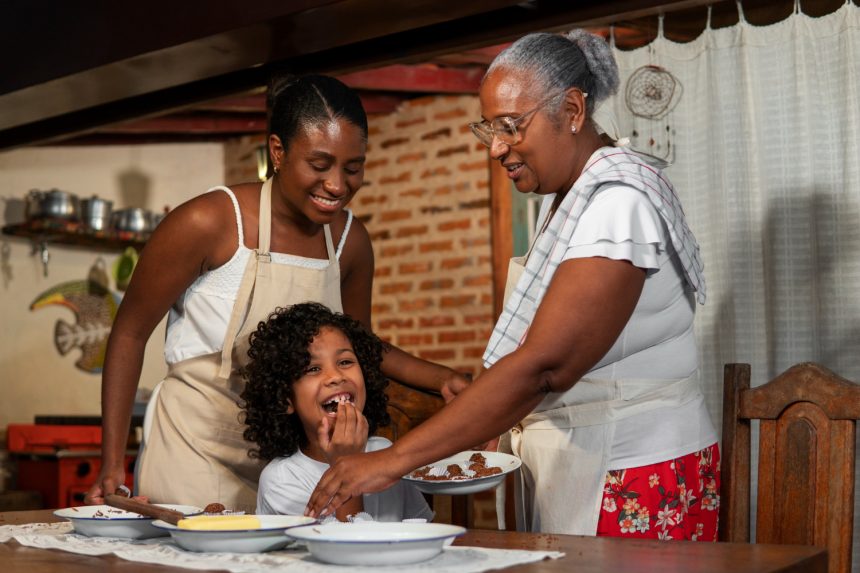
Food traditions operate on multiple registers simultaneously. At the material level, specific dishes connect families to geography, climate, and agricultural patterns of their cultural origin. At the symbolic level, particular foods become associated with comfort, celebration, or solemnity. The preparation and sharing of these foods creates opportunities for intergenerational interaction and skill transmission. A grandmother teaching a grandchild to make jollof rice or pierogi or mooncakes is transferring not just technique but an entire relationship to ingredients, time, and the meaning of feeding others. The kitchen becomes a site where identity is literally handed down, one repeated gesture at a time.
Stories and narratives shape family identity by providing interpretive frameworks. Every culture offers templates for understanding family relationships: what constitutes filial duty, how conflict should be addressed, which family bonds take precedence, how individual desires should be balanced against collective needs. These templates are transmitted through explicit stories about ancestors, through proverbs and sayings that encode cultural wisdom, and through the stories families tell about themselves.



The values embedded in cultural traditions are perhaps the least visible but most powerful mechanism of influence. These values operate as background assumptions about what matters, what constitutes success, how individuals should relate to community, and what obligations family members hold toward each other. A family shaped by Confucian traditions valuing filial piety and collective harmony will interpret a child’s career choice differently than a family shaped by individualist traditions celebrating personal ambition and self-actualisation, even when both families live in the same city and face similar economic pressures. These divergent interpretations are not merely different opinions. They reflect fundamentally different frameworks for understanding what family membership means.
The Pressure Points
The shaping influence of cultural traditions becomes most apparent where tension emerges. Generational differences create the most common friction point. Children raised in contexts different from their parents’ experience often find cultural traditions feeling simultaneously important and constraining. They may value the identity and belonging traditions provide whilst chafing at specific expectations or practices that seem misaligned with their contemporary reality.
This tension is not simply about young people rejecting old ways. It reflects a genuine dilemma: how to maintain meaningful connection to cultural inheritance whilst adapting to changed circumstances. A British-Nigerian teenager who feels fully British but is told by relatives that she is “really Nigerian” occupies complicated terrain. A second-generation Chinese Canadian who speaks English fluently but struggles with Mandarin lives the tension between belonging and distance daily. These young people are not confused about their identity. They are navigating the gap between inherited categories and lived experience.
Mixed cultural backgrounds introduce additional complexity. When parents bring different cultural traditions to a family, they must negotiate which practices to maintain, how to integrate potentially conflicting values, and which aspects of each tradition their children will inherit. These families do not simply choose between traditions. They create hybrid family identities that draw selectively from multiple sources whilst remaining fully authentic to neither.
The negotiation is rarely equal. Dominant cultures exert pressure that makes maintaining minority traditions require deliberate effort. A family attempting to transmit traditions that the surrounding society treats as foreign, exotic, or irrelevant must work actively against forces that make assimilation the path of least resistance. This asymmetry affects not just which traditions survive but how families perceive their own identity in relation to broader society.
Geographic distance from cultural homelands creates its own pressures. Traditions that made intuitive sense in their original context may require explanation or justification when practiced far from where they originated. The effort required to maintain traditions increases whilst the social reinforcement for doing so decreases. Some families respond by intensifying traditional practices, using them as anchors to identity in unfamiliar contexts. Others allow traditions to attenuate, unable or unwilling to sustain practices without the supporting cultural infrastructure.
Economic factors intersect with these pressures in material ways. Some cultural traditions assume resources or time that families may not possess in their current circumstances. When both parents work demanding jobs, maintaining elaborate food traditions may become impractical. When families experience economic precarity, directing resources toward cultural celebrations may compete with immediate needs. These constraints force families to prioritise, and the choices they make shape how cultural traditions influence their identity.
Related Articles

The Contemporary Context
Globalisation and increased mobility have intensified both the importance of cultural traditions for family identity and the complexity of maintaining them. Families dispersed across multiple countries or continents must find ways to transmit traditions without the daily reinforcement that geographic proximity once provided. Technology enables new forms of connection, but video calls cannot replicate the embodied experience of participating in cultural practices together. A grandparent teaching a recipe over video chat conveys information but not the physical co-presence that makes transmission feel like inheritance.
Intermarriage and cross-cultural partnerships have become increasingly common, creating families where cultural tradition cannot be taken as given but must be negotiated. These families face practical questions: which holidays to celebrate, which language to speak, which values to prioritise when traditions conflict. A family with one parent from a Muslim background and another from a Catholic background must decide which religious rituals, if any, to maintain, how to explain their choices to extended family, and what hybrid identity they are constructing. The answers they develop often involve creating new family traditions that honour multiple inheritances whilst remaining distinct from both. These negotiations are not problems to solve but processes through which family identity is defined.
Social media has introduced a performative dimension that fundamentally alters the nature of cultural transmission. Traditions once practised for continuity are now curated for visibility. When families photograph elaborate holiday meals for Instagram or document cultural celebrations for TikTok, the primary audience shifts from internal to external. This transformation is not entirely negative. Sharing practices online can create community with others navigating similar identities and provide models for younger generations. However, it risks reducing complex traditions to aesthetic content, divorcing them from deeper significance. The question becomes whether families are maintaining traditions because they generate meaning or because they generate engagement.
Why This Matters
Understanding how cultural traditions shape family identity matters because it illuminates a fundamental tension in modern life. Societies that value individual autonomy and self-determination also contain families whose identity is partly determined by inheritances they did not choose. This is not a problem to be solved but a condition to be understood.
Cultural traditions provide families with resources for meaning-making that individual creativity alone cannot generate. They offer tested ways of marking life transitions, processing grief, celebrating joy, and understanding obligations. To recognise oneself in ancestral practices, to share customs with extended family, to participate in traditions that connect to specific histories and places, these experiences create a sense of rootedness that purely chosen identities cannot replicate. This rootedness becomes particularly significant for children growing up in mobile, fragmented societies where other forms of continuity may be absent. When cultural traditions weaken, family identity does not disappear. It becomes thinner, more dependent on individual preference than shared inheritance, more vulnerable to the centrifugal forces of modern life.
However, the shaping influence of cultural traditions can also constrain. When traditions encode expectations about gender roles, appropriate ambitions, or acceptable life paths, they can limit individual flourishing. When traditions demand conformity to specific practices regardless of personal meaning, they can become burdensome obligations rather than sources of identity. The line between cultural inheritance as resource and cultural inheritance as constraint is not always clear.
Families navigate this tension in diverse ways. Some prioritise continuity, maintaining traditions even at personal cost because they value the identity and community these practices sustain. Others prioritise adaptation, modifying or abandoning traditions that no longer serve their circumstances. Most occupy a middle ground, selectively maintaining some traditions whilst allowing others to fade, creating family identities that blend inheritance with innovation.
The process of transmission itself shapes family identity as much as the content being transmitted. Families who engage deliberately with their cultural traditions, discussing why certain practices matter and how they might be adapted, develop different identities than families who maintain traditions without examination. The former creates space for members to claim cultural inheritance actively rather than simply receiving it passively. The latter provides the security of continuity but may struggle when younger generations question practices they have not been invited to interpret.
Living with Inheritance
Cultural traditions shape family identity not through determinism but through influence. They provide patterns that families can follow, modify, or reject, but even rejection is shaped by what is being rejected. A family that deliberately abandons certain cultural practices is no less shaped by those traditions than a family that maintains them. The traditions remain present as absence, defining the identity being constructed in opposition to them.
The families who manage this relationship most successfully are often those who approach cultural traditions with what might be called critical appreciation. They recognise that traditions carry both wisdom and limitation, that practices meaningful in one context may require adaptation in another, and that transmission can involve transformation. This approach allows families to maintain connection to cultural inheritance whilst remaining responsive to the actual lives they are living.
We are never entirely self-created. The meanings we inhabit, the practices we find significant and the values we hold all draw on inheritances larger than ourselves. Recognising this does not diminish individual agency. It locates that agency within its actual context: families embedded in cultural traditions, navigating between continuity and change, creating identities that are simultaneously inherited and original.